Meta Description: Choosing the right commercial food slicer? Compare blade sizes, gear-driven vs belt-driven motors, cast iron vs aluminum housings, and container loading economics. Featuring AIMA’s MS-2203, MS-2202, MS-2201, and MS-1909 with detailed specs, factory photos, and wholesale pricing guidance.
Slug: commercial-food-slicer-buying-guide
Focus Keyphrase: commercial food slicer buying guide
SEO Title: Commercial Food Slicer Buying Guide 2026 | Blade Size, Motor & Housing Comparison
Related Keyphrase: heavy duty meat slicer, electric food slicer wholesale, gear driven food slicer, cast iron meat slicer, 8.7 inch food slicer
Whether you run a busy deli counter, a high-volume restaurant kitchen, a butcher shop, or a supermarket fresh department, one piece of equipment directly impacts your daily efficiency, food consistency, and labor costs: the commercial food slicer. Yet most buyers make their decision based on just two factors — blade size and price — overlooking the engineering details that determine whether a machine lasts five years or five months.
This guide breaks down every variable that matters: drive mechanism, housing material, blade specs, thickness control precision, and the container economics that wholesalers and multi-location buyers need to understand. All product examples reference the AIMA commercial food slicer lineup, manufactured by Zhongshan AIMA Electrical Appliance Co., Ltd. — a 15-year ISO9001-certified factory exporting directly to over 30 countries.
1. Gear Drive vs. Belt Drive: The Decision That Determines Durability
Open up any commercial food slicer and the first thing you should look at is the drive mechanism — the system that transfers motor power to the spinning blade. This single engineering choice determines how the machine handles dense product, how long it lasts under daily use, and whether it maintains consistent RPM under load.
| Factor | Belt Drive | Gear Drive (AIMA Standard) |
|---|---|---|
| Torque under load | Belt slips when blade meets resistance — inconsistent slices | Positive engagement — no slip, consistent RPM regardless of product density |
| Lifespan | Rubber belt degrades, stretches, and eventually snaps — replacement every 6–18 months | Metal gears rated for the full service life of the machine — no consumable replacement |
| Noise | Quieter initially, but squeals as belt wears | Consistent mechanical hum — predictable and non-intrusive |
| Maintenance | Requires belt tensioning, alignment checks, and periodic replacement | Minimal — periodic lubrication only |
| Best for | Light home use, occasional slicing | Deli counters, restaurants, butcher shops, supermarket fresh departments |
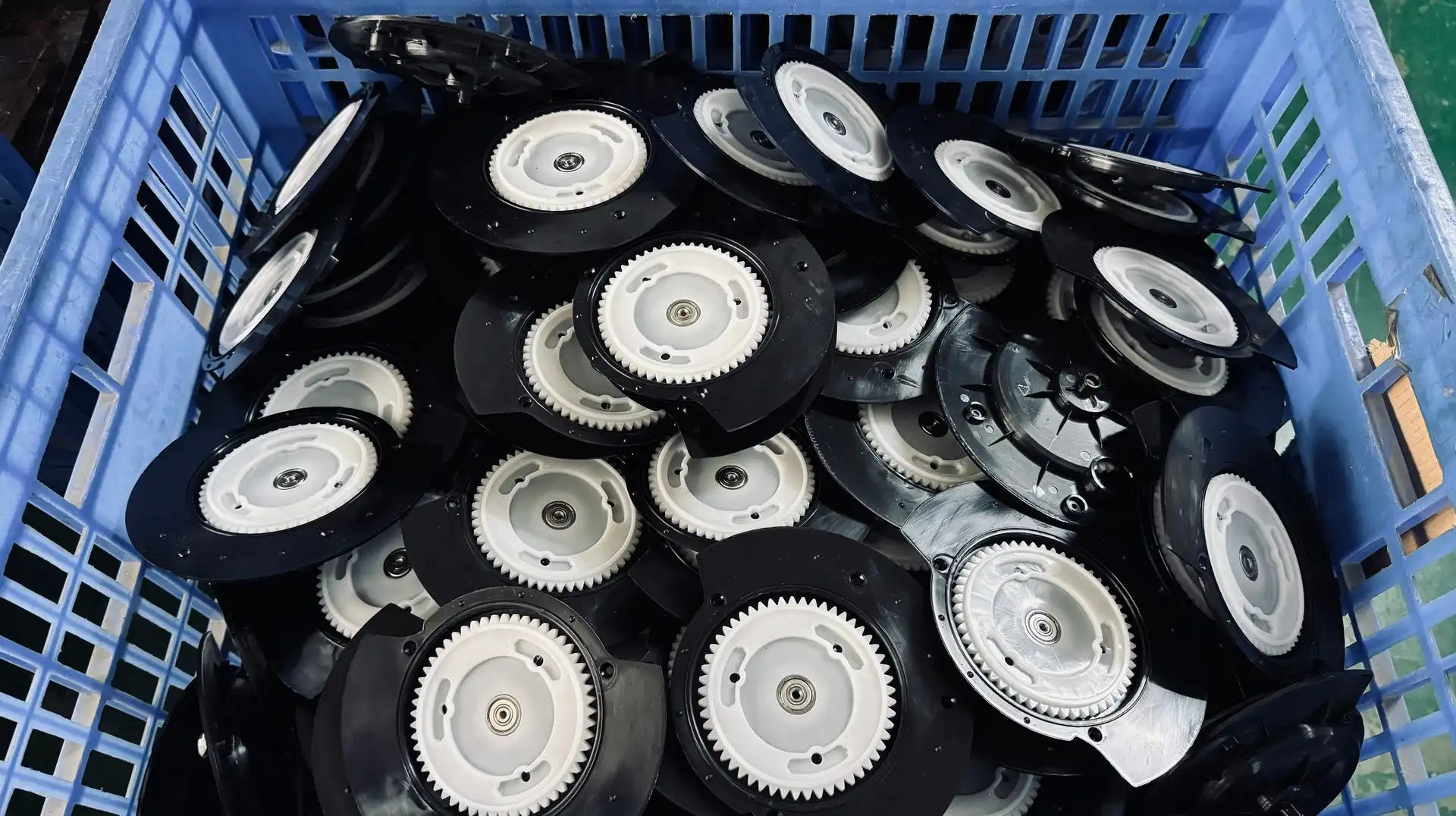
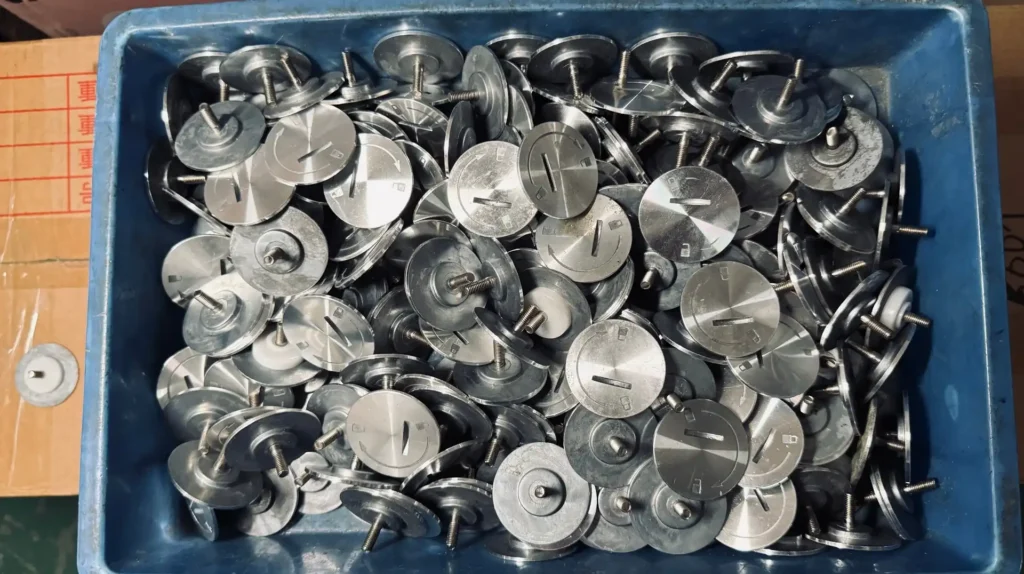
Precision-machined all-metal gear components inside every AIMA slicer. Unlike belt-driven competitors, these gears deliver stall-free torque through frozen meat, hard cheeses, and dense produce without degradation.
Bottom line: If you are buying for a business — any business — choose gear drive. The replacement cost of a belt-driven slicer that fails mid-shift far exceeds the modest price difference at purchase. Every model in AIMA’s food slicer lineup — MS-2203, MS-2202, MS-2201, MS-1909, and MS-1701 — uses a gear-driven transmission as standard.
2. Housing Material: Cast Iron vs. Aluminum Casting vs. Plastic
The slicer’s housing is not just an aesthetic shell — it is the structural frame that absorbs vibration, prevents blade wobble, and keeps the machine stationary on the counter during operation. A lightweight machine that walks across the table while slicing is both a safety hazard and a productivity killer.
| Housing Type | Weight | Stability | Durability | AIMA Models |
|---|---|---|---|---|
| Iron Casting | Heaviest (18–22 kg) | Excellent — anti-drift reinforcement ribs prevent counter movement | Maximum — resists dents, absorbs vibration, no flex under load | MS-2203, MS-2202, MS-1909 |
| Aluminum Casting | Mid-weight (14–17 kg) | Good — lighter but still rigid | Very good — corrosion-resistant, lighter for repositioning | MS-2201 |
| Plastic / ABS | Light (5–8 kg) | Poor — prone to drift and vibration | Low — cracks under impact, flexes under load | None — AIMA does not manufacture plastic-housing slicers |
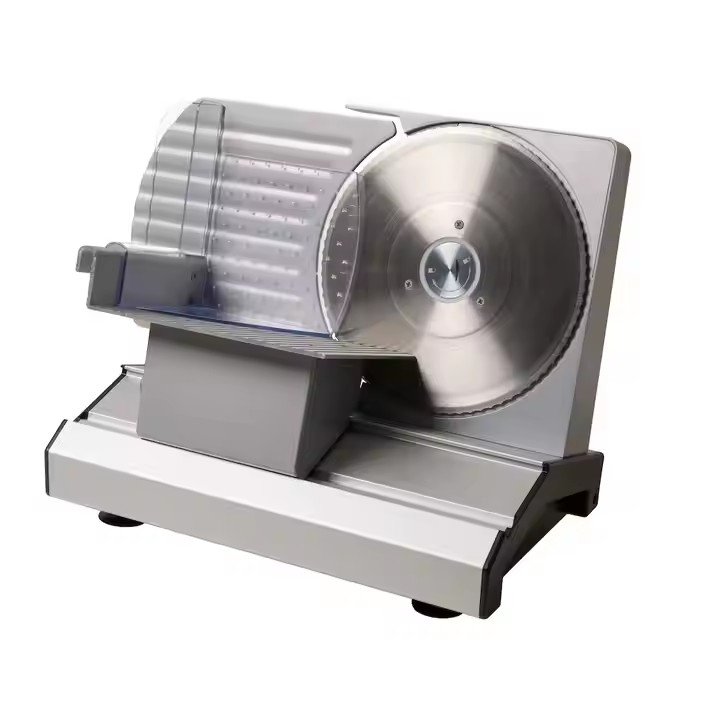
The MS-2202: iron casting housing with anti-drift reinforcement ribs. At 20+ kg, it stays planted on the counter even when slicing through frozen product — a critical safety and consistency feature for commercial environments.
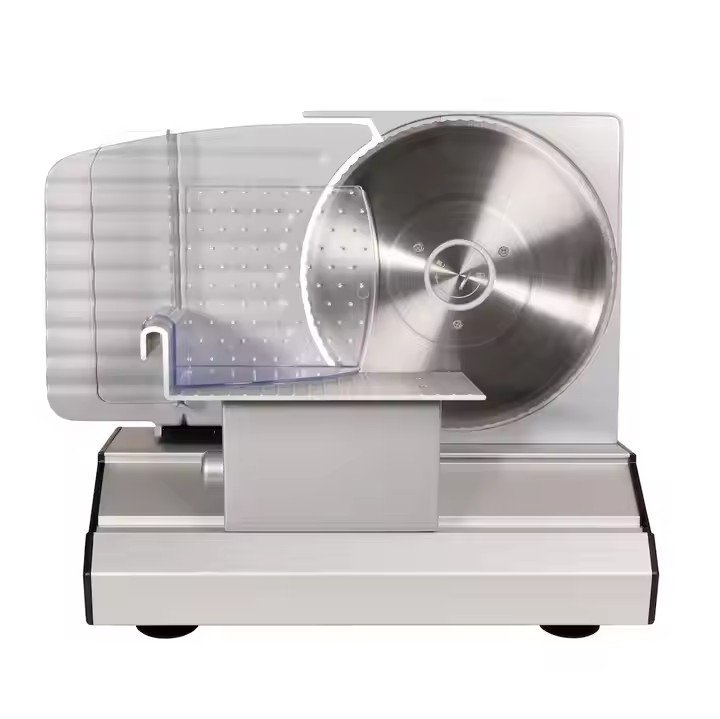
The MS-2201: aluminum casting housing. Lighter than iron but still rigid, this is the preferred choice for operations that need to reposition the slicer daily or where counter space is reconfigured frequently.
How to choose: If the slicer will live in one permanent position on a dedicated counter, go with iron casting — the extra weight is a feature, not a drawback. If you need mobility or are optimizing for container-loading density as a wholesaler, aluminum casting (MS-2201 at 1,428 units per 40HQ) offers the best economics without sacrificing structural integrity.
3. Blade Size: 6.7″, 7.5″, or 8.7″ — What’s Right for Your Product Mix?
Blade diameter determines the maximum product width you can slice in a single pass. This seems obvious, but the real consideration is not just “what size cheese do I slice today?” — it is about labor efficiency. A smaller blade means more passes per product, which means more labor time per pound sliced.
| Blade Size | Best For | Typical Products | AIMA Model | Blade Material |
|---|---|---|---|---|
| 170mm (6.7″) | Small delis, cafes, entry-level commercial | Sandwich meats, small cheese blocks, vegetables | MS-1701 | Stainless Steel |
| 190mm (7.5″) | Mid-volume delis, butcher shops | Standard deli meats, medium cheese wheels, bacon | MS-1909 | Stainless Steel |
| 220mm (8.7″) | High-volume delis, supermarket fresh departments, meat processing | Large roasts, whole cheeses, frozen product, bulk processing | MS-2203, MS-2202, MS-2201 | Stainless Steel |
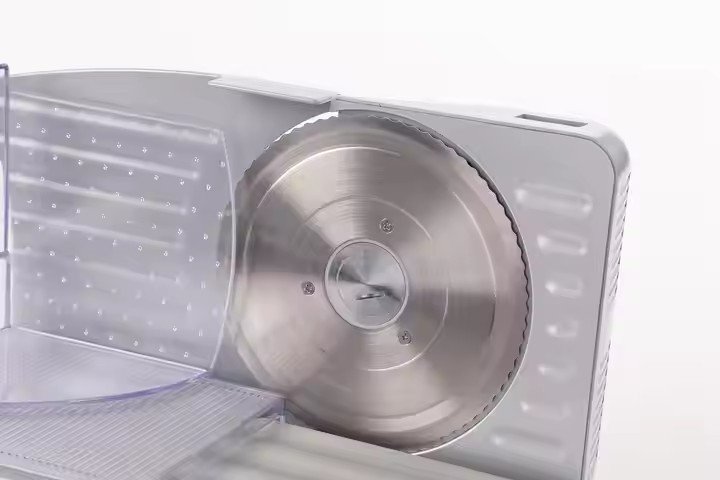
The MS-1701’s 170mm stainless steel blade: ideal for small to mid-sized deli operations. All AIMA blades are removable for sharpening and sanitizing — a detail that matters for health code compliance.
Practical advice: If 80% of your slicing volume fits within a 7.5″ blade, but 20% requires an 8.7″ blade, buy the larger machine. The labor savings from single-pass slicing on that 20% will pay for the price difference within months. For wholesalers and distributors, offering both sizes — like the MS-1909 (7.5″) and MS-2202 (8.7″) — covers both price-sensitive and performance-focused customer segments in a single product category.
4. Thickness Control: The Difference Between “Adjustable” and “Precision”
Every slicer claims to offer adjustable thickness. The question is: how precise and how repeatable? A deli that sells prosciutto by weight needs paper-thin, consistent slices every time. A butcher shop cutting steaks needs clean, uniform 20mm cuts. If the thickness mechanism drifts during operation — a common problem with budget slicers — you are losing money on every inconsistent slice.
AIMA’s thickness control system operates on a precision knob with graduated scale markings, offering 0–20mm adjustment across all models. The mechanism is mechanical and direct — no electronic drift, no recalibration needed between shifts.
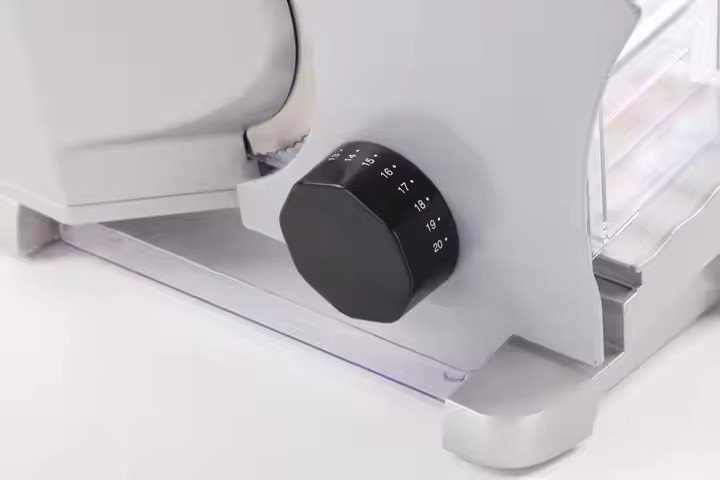
Close-up of the precision thickness control knob. The graduated scale allows operators to document settings per product (e.g., “prosciutto = setting 2, steak = setting 18”) and return to exact thickness on every shift change — a small detail with big implications for portion control and food cost management.
5. Motor Power and Voltage: What You Need for Your Market
AIMA’s food slicers use a 220W motor — a specification that is easy to overlook but critical to understand. In the slicer market, 220W represents the sweet spot between sufficient cutting power and manageable energy consumption for continuous commercial use. Lower-wattage slicers (100–150W) struggle with dense product and overheat during extended operation. Higher-wattage units add unnecessary electricity cost without proportionate slicing performance gains.
For international buyers, voltage flexibility is non-negotiable. AIMA slicers are available in 120V (North America), 220–240V (Europe/Asia), and other regional voltage configurations — a factory-direct OEM capability that trading companies often cannot accommodate without MOQ penalties. This is particularly important for:
- Amazon FBA sellers — who need 120V for the US market but may expand to 220V for Amazon EU
- Supermarket chains — operating across multiple countries with different electrical standards
- Hotel groups — outfitting properties in different regions from a single procurement contract
6. Model Comparison: Which AIMA Slicer Fits Your Operation?
Rather than listing specs in isolation, here is a side-by-side comparison organized by use case — the way a real buyer thinks about selection:
| Use Case | Recommended Model | Why | Product Page |
|---|---|---|---|
| High-volume supermarket deli | MS-2203 | 8.7″ blade, iron casting, gear drive — maximum durability for all-day slicing. Handles frozen product, large cheese wheels, bulk roasts without slowing down. | View MS-2203 |
| Mid-volume restaurant or butcher shop | MS-2202 | Same 8.7″ blade and iron casting as the MS-2203, optimized for operations that need pro-grade reliability without the absolute highest output volume. | View MS-2202 |
| Multi-location chain, wholesale distribution | MS-2201 | Aluminum casting = lighter shipping weight = higher container density (1,428 units/40HQ). Same 8.7″ blade and gear drive — the best per-unit landed cost for bulk buyers. | View MS-2201 |
| Specialty food shop, compact deli | MS-1909 | 7.5″ blade in an iron casting housing — compact footprint, rock-solid stability, highest container load (1,500 units/40HQ). Ideal where counter space is limited but quality cannot be compromised. | View MS-1909 |
| Entry-level café, small deli startup | MS-1701 | 170mm blade, aluminum housing — the most affordable entry in the lineup without sacrificing gear-drive reliability. Perfect for operations processing under 50kg of product per day. | View MS-1701 |
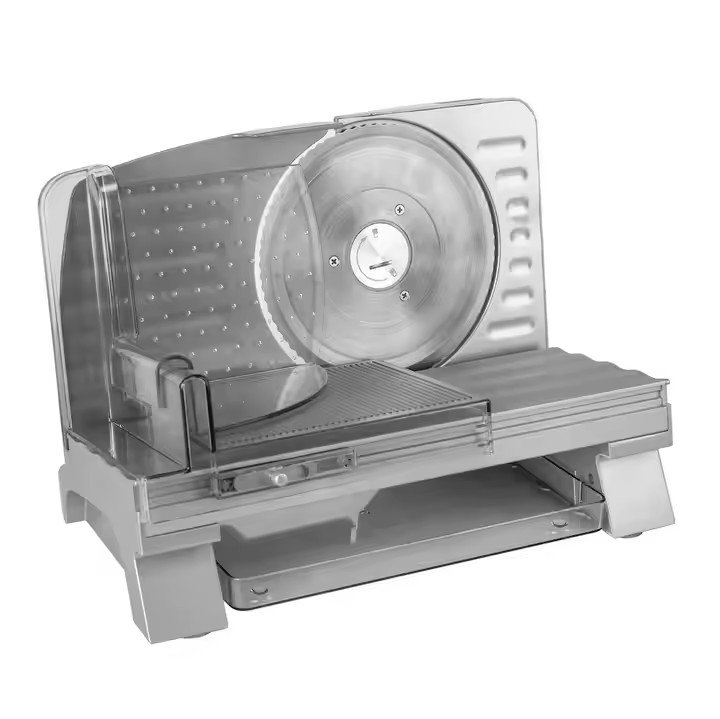
The MS-1701 in full view: compact, gear-driven, built for operations that need professional slicing quality in a smaller footprint. All AIMA models share the same core engineering DNA — gear drive, stainless steel blade, and precision thickness control — scaled to match different volume requirements.
7. The Factory Behind the Machine: Why Manufacturing Origin Matters
A slicer is only as reliable as the factory that produced it. When evaluating any commercial food slicer supplier, the factory’s quality infrastructure should carry as much weight in your decision as the product specifications themselves.
AIMA Electrical operates a 3,000m² facility in Zhongshan, Guangdong, under ISO9001 quality management and 5S production standards. The factory’s quality control system operates at three stages:
- IQC (Incoming Quality Control): 100% inspection of all critical components — motors, blade assemblies, electronic controls — before they enter the production floor
- In-process QC: In-house laboratory equipped for RoHS compliance testing, drop testing, vibration testing, glow-wire testing, ball-pressure testing, and leakage current testing
- Final inspection: Every completed unit passes electrical safety and performance verification before automated packaging
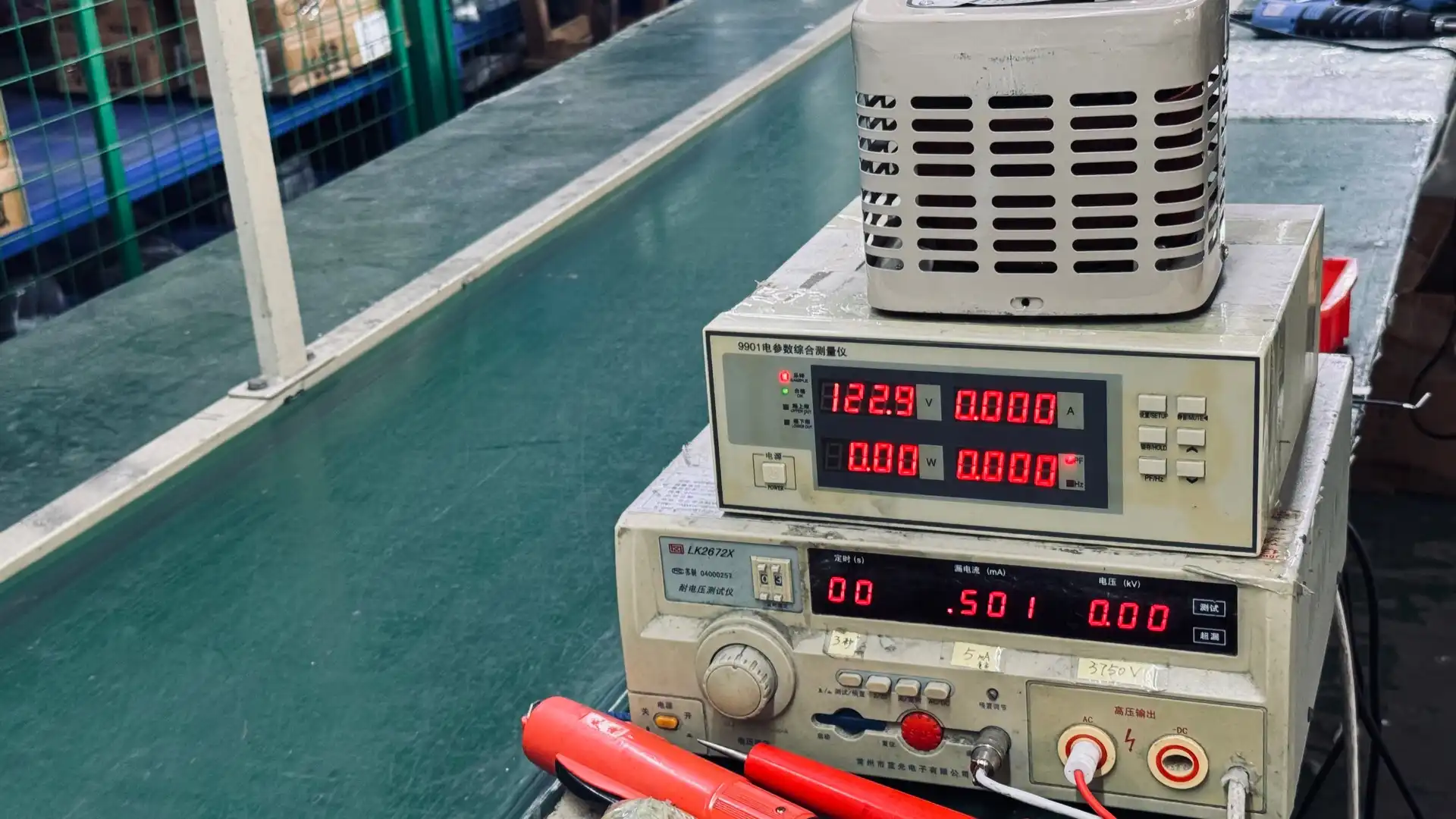
The 9901 electrical parameter and hipot testing station: every motor and electronic control passes through this checkpoint before assembly. For a slicer that runs 8–12 hours daily in a deli environment, this upstream QC is what prevents mid-shift failures.
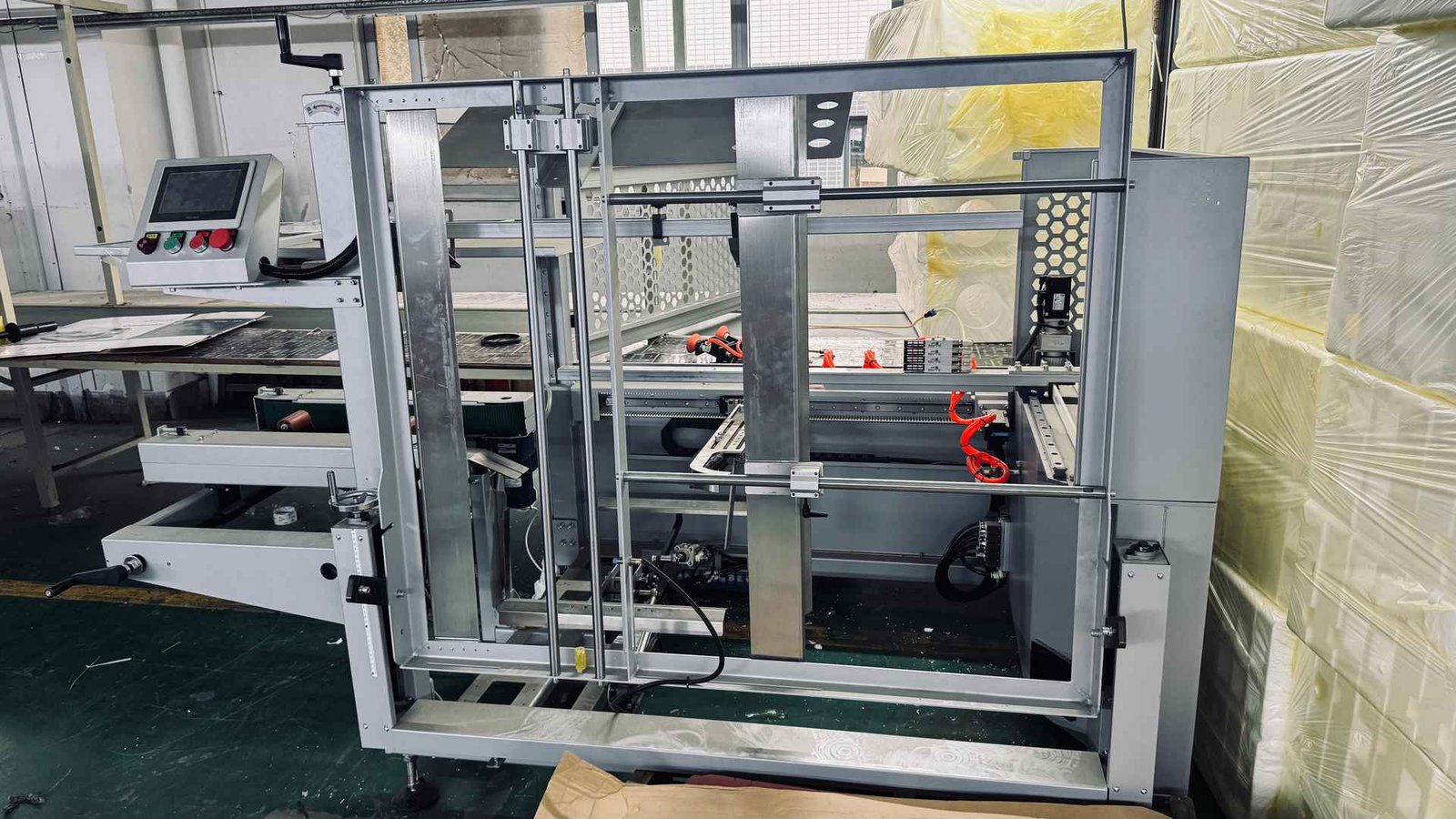
Automated packaging at the end of the production line: every slicer is sealed, strapped, and prepared for container shipping. Consistent packaging means consistent arrival condition — a detail that matters when you are receiving a pallet of slicers for retail distribution.
Products carry CE, CB, and RoHS certifications, with UL-ready design parameters for North American market entry. The factory exhibited at HOTELEX Shanghai 2026 (Hall 2.2, Booth B15) — a verifiable trade show presence that trading companies cannot fabricate. See AIMA’s HOTELEX booth recap here.
8. Container Loading Economics: What Wholesale Buyers Need to Know
If you are a distributor, wholesaler, or multi-location chain importing slicers by the container, per-unit landed cost — not per-unit factory price — is the number that drives your business model. Container loading density directly determines your per-unit shipping cost, and small differences in packing efficiency translate to meaningful margin differences at scale.
| Model | Blade | Housing | Units per 40HQ | Best Wholesale Application |
|---|---|---|---|---|
| MS-1909 | 7.5″ | Iron Casting | 1,500 | Highest density — lowest per-unit freight. Ideal for price-sensitive wholesale distribution of a compact, durable machine. |
| MS-2201 | 8.7″ | Aluminum Casting | 1,428 | Best balance of large blade + high density. The margin-optimized choice for 8.7″ slicer distribution. |
| MS-2202 | 8.7″ | Iron Casting | 1,380 | Premium full-iron 8.7″ option — higher per-unit freight offset by premium retail pricing. |
| MS-2203 | 8.7″ | Iron Casting | 1,380 | Flagship premium model — same density as MS-2202, positioned at the top of the retail price tier. |
A smart mixed-container strategy: combine MS-1909 units (value-tier, 1,500/40HQ) with MS-2202 units (premium-tier, 1,380/40HQ) to serve both price-sensitive and performance-focused customers in one shipment. AIMA’s logistics team can provide mixed-container loading plans before you issue a purchase order.
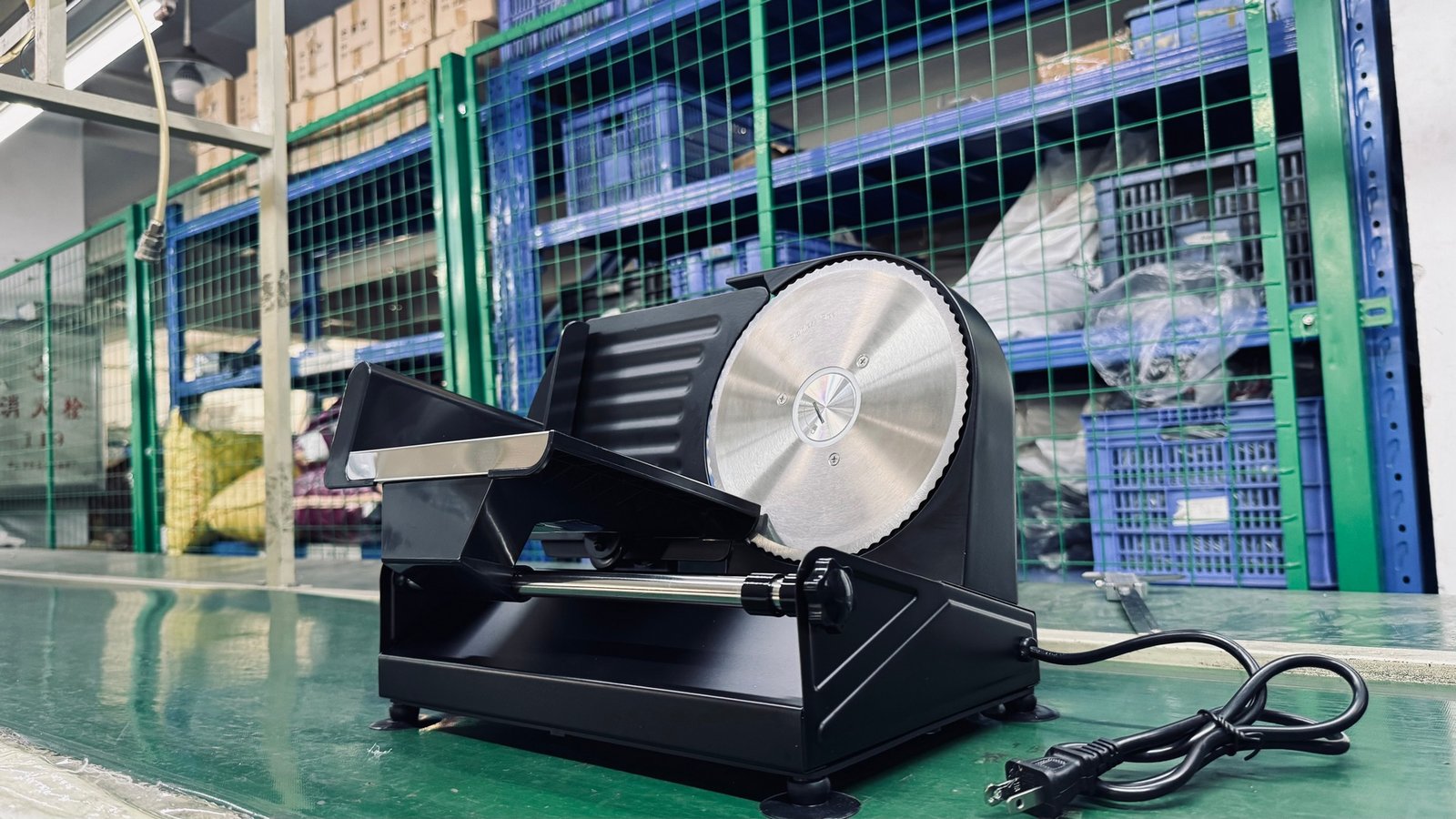
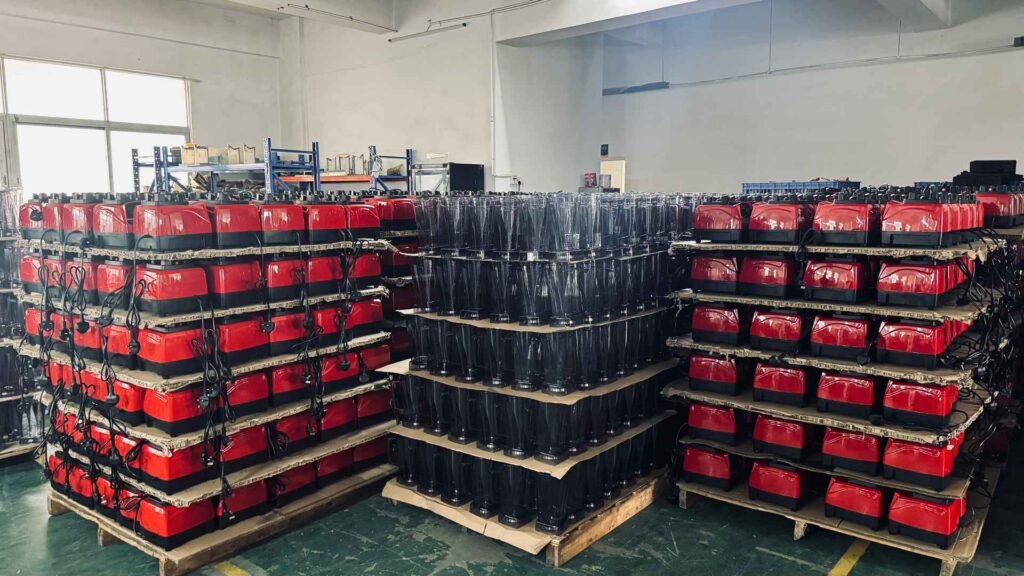
AIMA’s finished goods warehouse: slicers are staged and ready for immediate container loading. Factory-direct procurement means you are not waiting on a trading company to coordinate with a third-party warehouse — your order moves from production line to container on a single timeline.
9. OEM/ODM: Putting Your Brand on a Proven Machine
For distributors, retail chains, and private-label brands, the ideal scenario is to sell a proven, reliable machine with your own logo on it. AIMA’s OEM/ODM program supports this at container-scale volumes with factory-direct communication — no intermediary to miscommunicate your brand requirements:
- Voltage & plug type — built to your target market’s electrical standard
- Housing color & finish — match your brand palette for retail shelf consistency
- Logo placement — laser engraving, silk screening, or embossed branding on the housing
- Packaging design — full retail box with your branding, barcode, and multi-language manual; or neutral export cartons for B2B distribution
- Accessory configuration — spare blades, cleaning kits, sharpening stones — bundled to match your sales strategy
Because OEM communication happens directly with the production team — not through a trading agent — specification accuracy is dramatically higher. The engineer who will build your branded unit receives your requirements directly, eliminating the translation errors that plague multi-layer sourcing.
10. Maintenance and Serviceability: What to Expect Over the Machine’s Lifetime
A commercial food slicer is a capital investment, not a disposable appliance. Its total cost of ownership includes maintenance, blade sharpening, and parts replacement over a 5–10 year service life. Here is what to expect with AIMA slicers:
| Maintenance Item | Frequency | Details |
|---|---|---|
| Blade sharpening | Weekly to monthly (depending on volume) | Removable stainless steel blade — compatible with standard commercial blade sharpeners. Built-in sharpening stone on select models for daily edge maintenance. |
| Gear lubrication | 6–12 months | Food-grade grease on the gear drive assembly. Metal gears do not degrade — lubrication is preventive, not corrective. |
| Thickness mechanism calibration | As needed (typically annual) | Mechanical direct-drive system holds calibration far longer than electronic alternatives. If adjustment is needed, it is a mechanical procedure — no electronics to fail. |
| Blade replacement | 3–5 years (heavy commercial use) | Full blade assembly is designed for field replacement. Stocking a spare blade means zero downtime during resharpening cycles. |
| Motor | Designed for machine lifetime | 220W motor rated for continuous commercial duty. Not a consumable component under normal operating conditions. |
Parts availability: As a factory-direct manufacturer (not an assembler relying on third-party components), AIMA maintains inventory of replacement parts for all current models. For wholesale buyers, this means you can stock spare blades, sharpening stones, and wear components alongside your initial order — creating an ongoing parts revenue stream for your own business.
11. Quick Decision Matrix: Which Slicer Should You Buy?
Answer these four questions and the right model becomes clear:
| If You Answer… | Your Best Model Is… | Key Reason |
|---|---|---|
| “I need the largest blade possible — we slice whole roasts and large cheeses daily.” | MS-2203 | Flagship 8.7″ iron casting — the most robust slicer in the lineup for maximum daily volume. |
| “We need professional 8.7″ performance but value is important.” | MS-2202 | Same blade and iron casting as MS-2203, optimized cost point for mid-volume commercial kitchens. |
| “We’re a wholesaler — per-unit landed cost is my top metric.” | MS-2201 | Aluminum casting = lighter shipping = 1,428 units/40HQ. Best margin for bulk 8.7″ distribution. |
| “Counter space is tight but we refuse to compromise on build quality.” | MS-1909 | 7.5″ blade in an iron casting body — compact, stable, 1,500 units/40HQ for wholesale efficiency. |
| “We’re a startup — need pro features at entry-level investment.” | MS-1701 | 170mm gear-driven — professional engineering in a smaller, more affordable package. |
Conclusion: Buy the Factory, Not Just the Machine
A commercial food slicer is a 5–10 year investment that directly affects your daily operations — product consistency, labor efficiency, and customer satisfaction all depend on it. The most important decision you make is not between blade sizes or housing materials: it is choosing a manufacturer who engineers for commercial reality, not consumer price points.
AIMA Electrical has spent 15 years refining exactly this: gear-driven transmissions that do not slip, cast metal housings that do not drift, and precision thickness controls that hold calibration shift after shift. With CE/CB/RoHS certifications, ISO9001 quality systems, and factory-direct OEM capability, they deliver what commercial kitchens actually need — reliability at volume, supported by verifiable manufacturing quality.
Ready to equip your operation? Browse the full commercial food slicer collection, compare detailed specifications on individual product pages, or contact Ricardo at sales1@zs-aima.com for wholesale pricing, OEM inquiries, and sample requests.
Keywords: commercial food slicer buying guide, heavy duty meat slicer, gear driven food slicer, cast iron meat slicer, electric food slicer wholesale, 8.7 inch food slicer, commercial deli slicer, food slicer OEM factory, restaurant meat slicer, supermarket deli slicer.