Inside a Tier-1 Commercial Blender Manufacturer: How We Build High-Performance OEM Appliances for US Brands
Table of Contents:
The Scale of Production: A Look Inside Our 3,000㎡ ISO9001 Facility
The Heart of the Machine: In-House 2200W Copper Motor Manufacturing
Passing US Safety Standards: Rigorous Hipot Electrical Testing
The Final Defense: Our Strict Quality Control & Finished Parts Area
Advanced Noise Reduction: Designing Soundproof Enclosures for Premium Cafes
Intelligent PCB Assembly & Custom Touch Control Programming
Food-Grade Materials: Heavy-Duty 304 SS Blades & Unbreakable PC Jars
Supply Chain Logistics: Fulfilling Bulk 40HQ Container Orders
How to Start Your B2B Custom Appliance Project with Us
Conclusion: The AIMA Manufacturing Difference
Frequently Asked Questions (FAQ)
Listen, if you are sourcing commercial kitchen equipment for the US market, I know exactly what you are up against. You are constantly navigating the gray area between trading companies pretending to be factories and actual manufacturers who might cut corners on internal components. When your clients—whether they are bustling coffee chains in Seattle or massive catering companies in New York—turn on a commercial blender, they expect power, consistency, and absolute safety. A burnt-out motor during the morning rush isn’t just a broken machine; it’s lost revenue and a damaged brand reputation.
That is why transparency is non-negotiable. Today, I am taking you behind the scenes. We are going to bypass the polished showroom and walk straight onto the factory floor of our Zhongshan AIMA manufacturing hub. You will see exactly how we engineer, assemble, and test high-performance commercial blenders designed specifically to meet the grueling demands and strict compliance standards of the North American market.
The Scale of Production: A Look Inside Our 3,000㎡ ISO9001 Facility
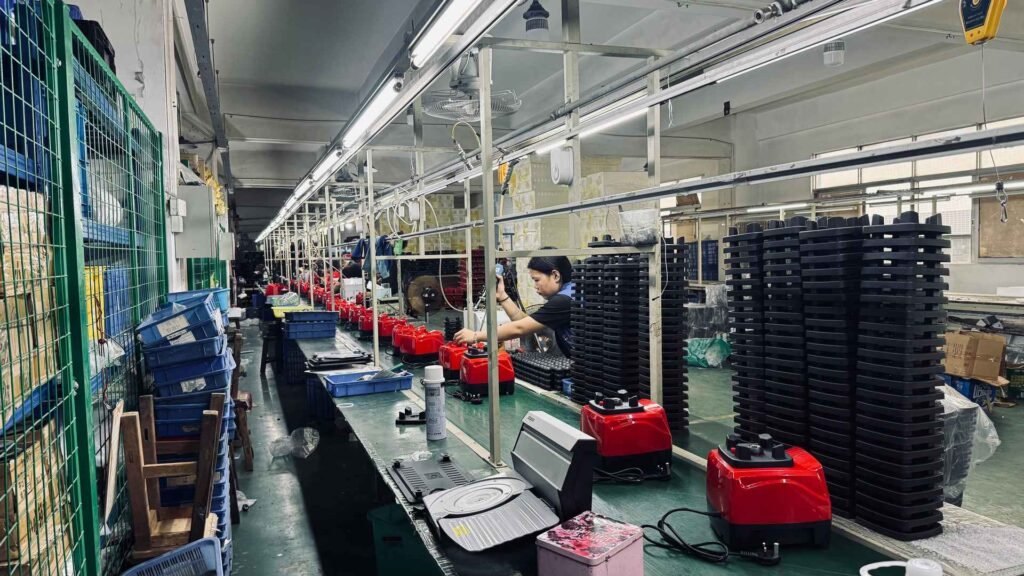
When you are scaling a brand across the United States, your supply chain needs to be bulletproof. A small assembly workshop simply cannot guarantee the volume or the consistency required for national distribution. Our operations are anchored in a state-of-the-art 3,000-square-meter facility, strictly governed by ISO 9001 quality management standards.
Take a look at our main production floor. We have heavily invested in automated conveyor systems and specialized workstations that allow for lean manufacturing. This isn’t just about speed; it’s about eliminating human error. By adhering to 5S factory management protocols (Sort, Set in order, Shine, Standardize, Sustain), we maintain an environment where precision thrives. Every component, from the ABS plastic housing to the tiny rubber shock absorbers, moves through a logically optimized pathway, ensuring that when you order a 40HQ container, machine number 1,200 is built with the exact same tight tolerances as machine number one.
Caption: A panoramic view of the AIMA commercial blender production workshop, demonstrating our scalable assembly lines and strict 5S factory management.
The Heart of the Machine: In-House 2200W Copper Motor Manufacturing
Let’s talk about the engine. If there is one place where budget manufacturers silently cut costs, it is the motor. They will use copper-clad aluminum (CCA) wiring or undersized stators to save a few dollars. The result? A machine that smells like burning plastic after blending three frozen margaritas.
We do not outsource our core powerplants. We manufacture our 2200W high-torque industrial motors entirely in-house using 100% pure copper winding. Why does pure copper matter so much for the US commercial market? Copper has superior electrical conductivity and significantly better heat dissipation compared to aluminum substitutes. When a barista is relying on a machine to crush ice at 24,000 RPM continuously for an hour, the motor needs to shed heat quickly. Our in-house manufacturing process gives us complete control over the winding density and the balancing of the rotor, resulting in a motor that delivers raw, uncompromising torque without catastrophic RPM drops when under heavy load.
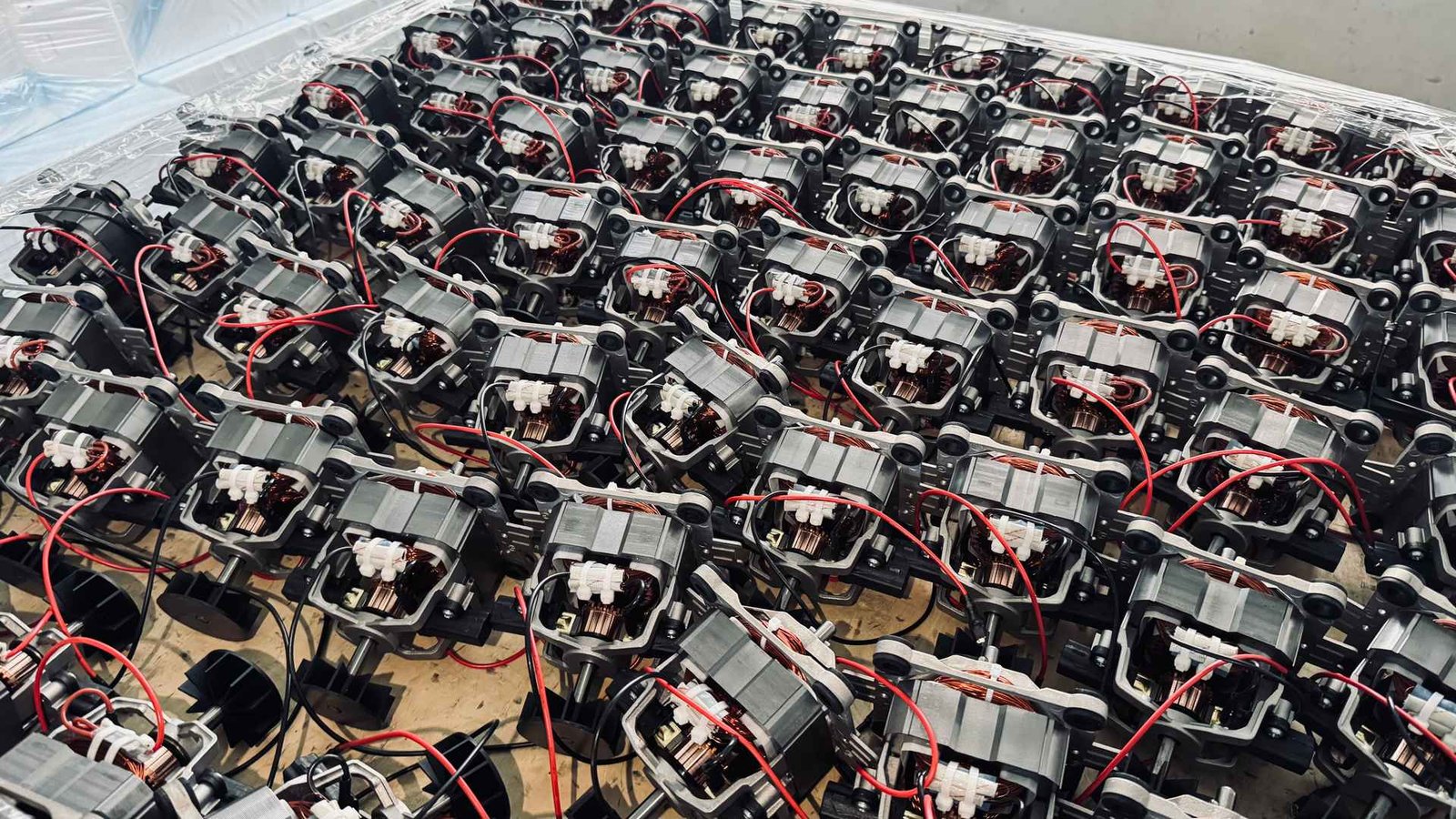
Caption: Massive inventory of our in-house manufactured 2200W pure copper motors, engineered for relentless high-torque performance and extreme durability.
Passing US Safety Standards: Rigorous Hipot Electrical Testing
Importing electrical appliances into the United States means clearing severe regulatory hurdles. Your products need to meet strict ETL or UL safety standards, and failure to comply can lead to devastating customs seizures or liability issues.
We don’t leave electrical safety to chance. Before any commercial blender chassis is closed, it must pass through our Hipot (High Potential) testing station. A Hipot test is a crucial dielectric withstand test. We apply a massive voltage—far higher than the standard 110V/120V US operating voltage—to the machine’s electrical isolation system. This ensures that the insulation around the pure copper motor and the intelligent circuitry is flawless. If there is even a microscopic flaw that could cause a short circuit or put a user at risk of a shock, the Hipot tester catches it instantly. When you partner with us, you are buying peace of mind, knowing that every single unit is electrically sound and compliance-ready.
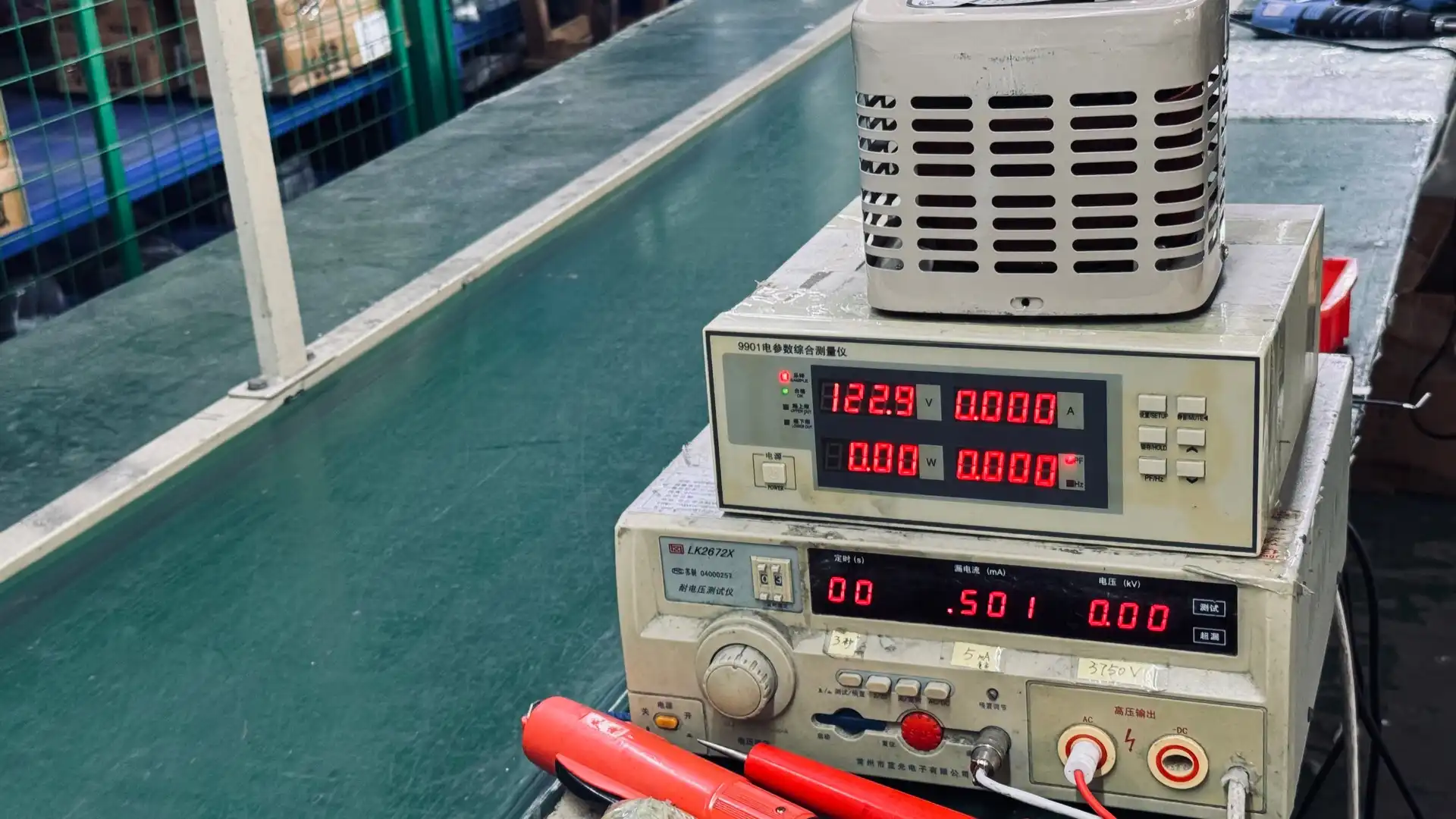
Caption: An AIMA factory technician utilizing advanced Hipot testing equipment to verify the electrical insulation and safety compliance of every commercial blender.
The Final Defense: Our Strict Quality Control & Finished Parts Area
Quality control shouldn’t just be a final glance before throwing a machine into a cardboard box; it must be a systematic defense line. Our QC protocol dictates that a machine is only as strong as its weakest sub-assembly.
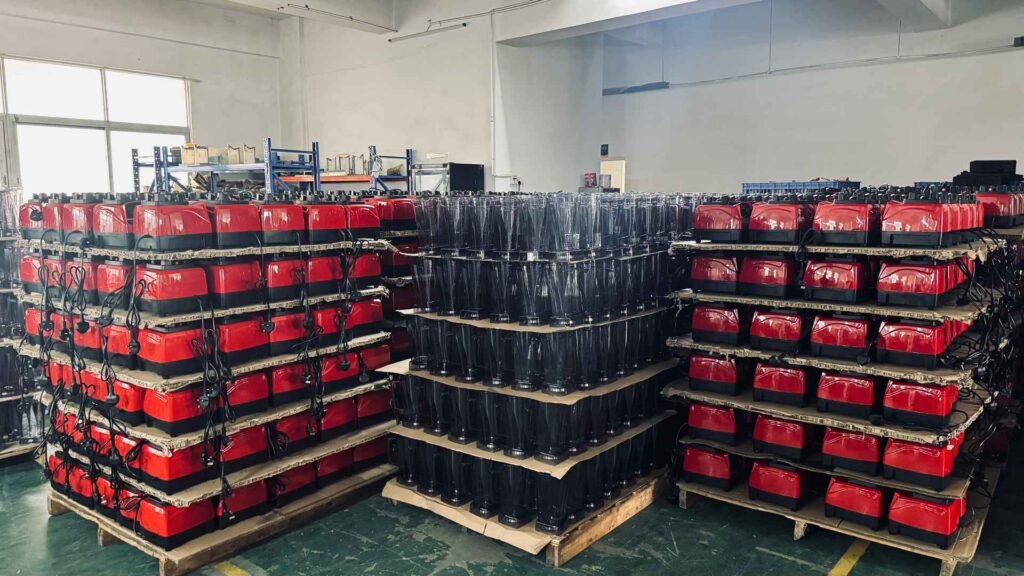
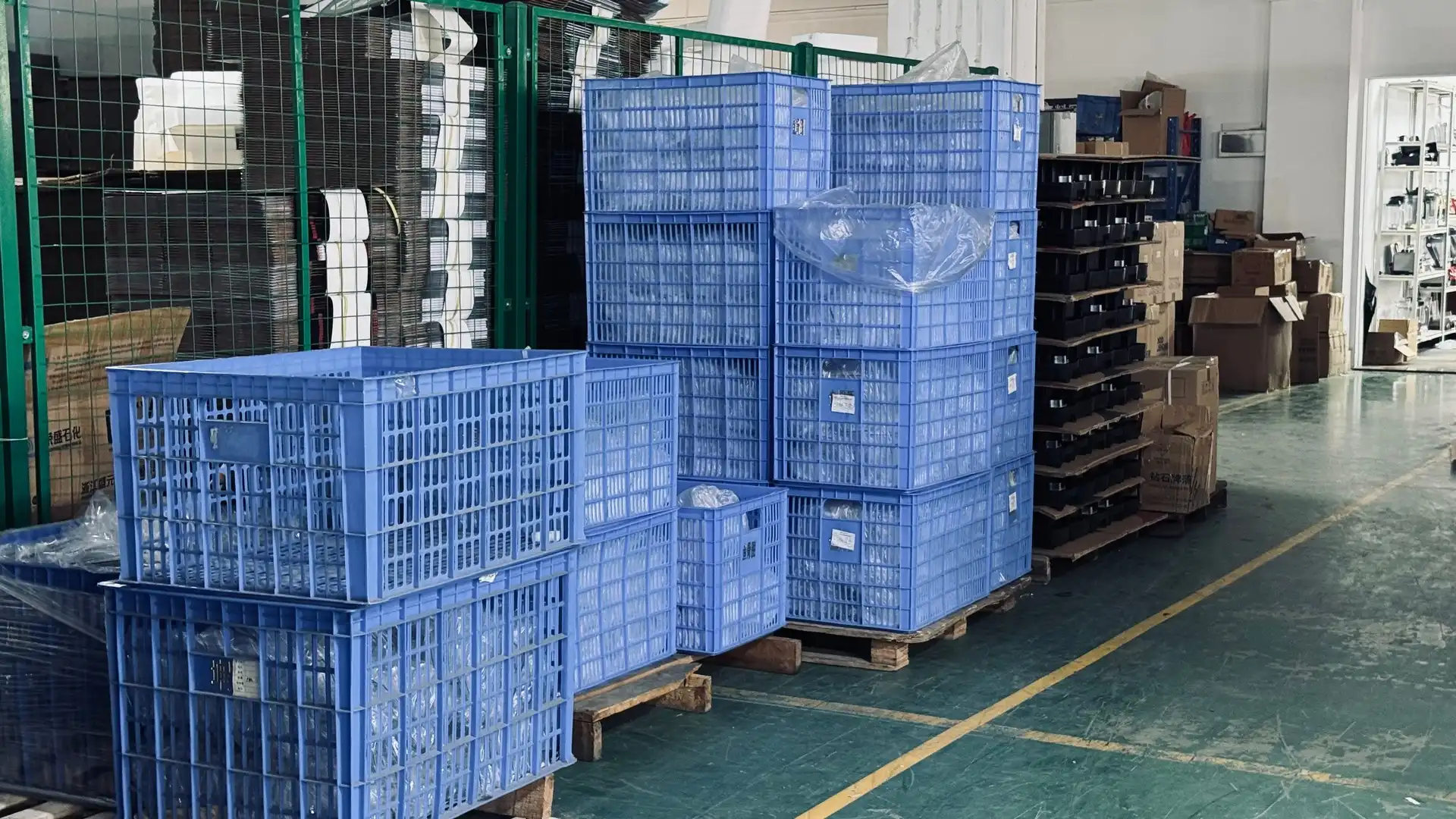
In our dedicated quality control area, finished parts and fully assembled units undergo grueling lifecycle simulations. We perform drop tests on the packaging to simulate rough ocean freight handling, vibration tests to ensure internal wiring harnesses don’t shake loose, and thermal load testing where machines run at maximum capacity until the thermal overload protection kicks in. Only when a batch achieves a 100% pass rate in these functional and cosmetic inspections is it cleared for staging. We believe that discovering a defect on our factory floor costs pennies, while discovering it in your customer’s kitchen costs a fortune.
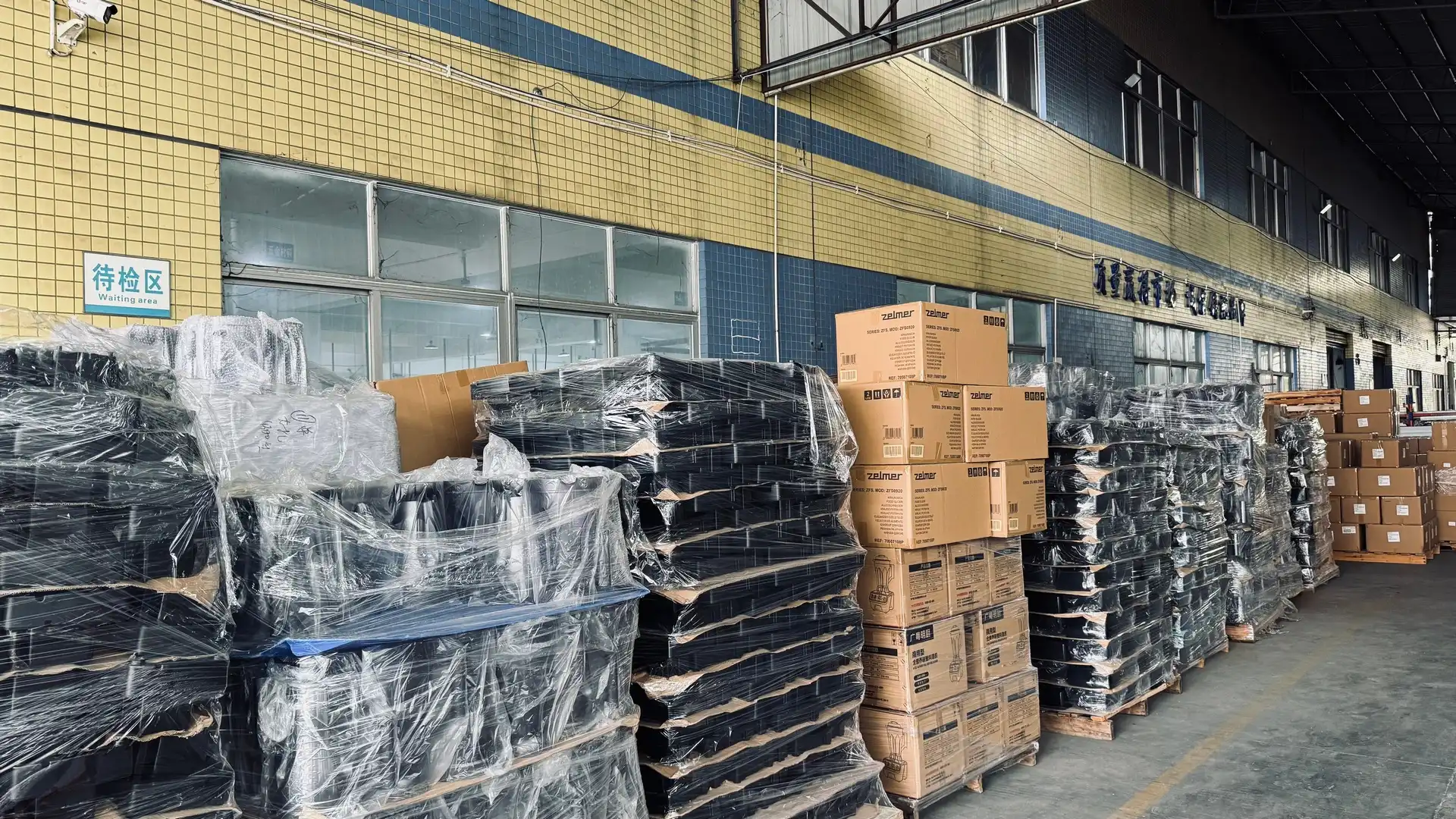
Caption: Our highly organized finished parts and quality control area, where every unit undergoes rigorous functional and cosmetic inspections before final packaging.
Advanced Noise Reduction: Designing Soundproof Enclosures for Premium Cafes
Have you ever tried having a business conversation in a cafe while a commercial blender sounds like a jet engine taking off three feet away? It ruins the customer experience. For premium hospitality environments, raw power must be paired with acoustic engineering.
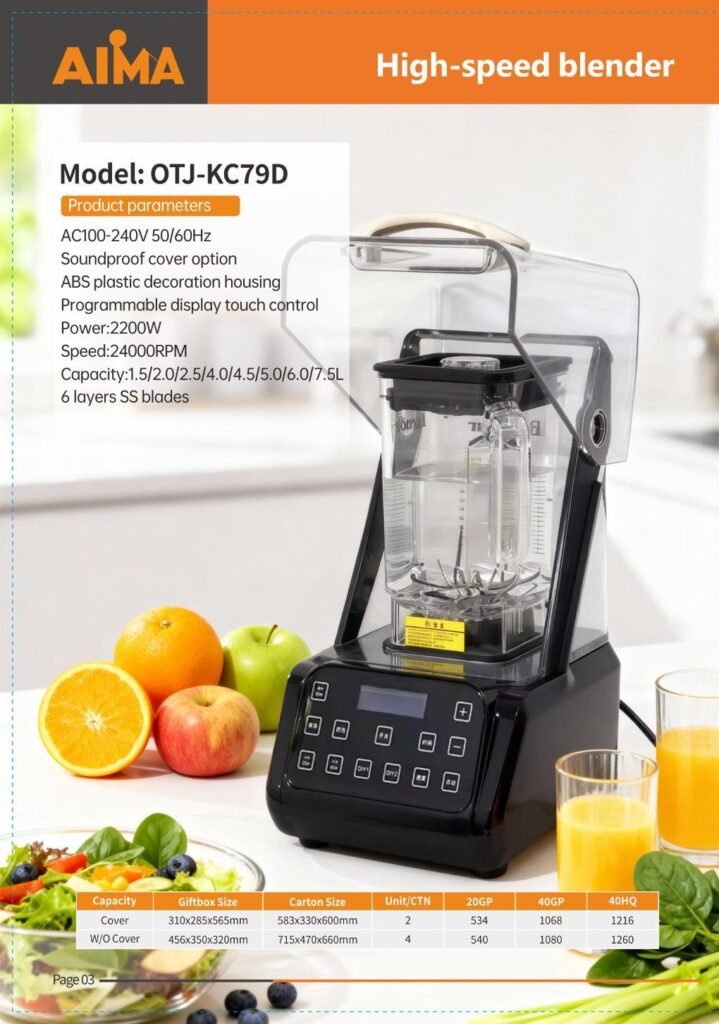
Our flagship models, like the OTJ-G9 and KC79D, feature custom-engineered soundproof enclosures. We use high-density polycarbonate shields combined with thick, specialized TPR (Thermoplastic Rubber) vibration-dampening base pads. This isn’t just a plastic box; it’s an acoustic chamber designed to trap and absorb the high-frequency mechanical noise generated by a 24,000 RPM blade slicing through frozen fruit. For US distributors targeting high-end coffee chains, this noise-reduction technology is an incredibly powerful selling point that immediately positions your brand against the industry’s most expensive tier-1 competitors.
Intelligent PCB Assembly & Custom Touch Control Programming
The modern commercial kitchen demands recipe standardization. A franchise owner in Texas needs their smoothies to taste exactly the same as their location in Florida. Mechanical knobs are great for seasoned chefs, but for fast-paced beverage chains, digital precision is king.
We design and program our own Printed Circuit Boards (PCBs). Our intelligent touch-control panels offer programmable multi-stage blending cycles. You can program the machine to pulse low for three seconds to crush large ice, ramp up to maximum speed for ten seconds to liquefy, and then taper off. Furthermore, our industrial PCBs are equipped with integrated overvoltage and overtemperature fail-safes. If a barista accidentally overloads the jar, the smart board shuts the motor down to protect the hardware, displaying a clear reset code instead of frying the circuits.
Food-Grade Materials: Heavy-Duty 304 SS Blades & Unbreakable PC Jars
When you are dealing with food service equipment, material safety is heavily regulated by bodies like the FDA. We never compromise on the materials that directly contact the ingredients.
Our jars are injection-molded from virtually unbreakable, food-grade polycarbonate (PC), capable of withstanding massive temperature fluctuations from boiling soups to frozen acai bowls. Inside the jar sits our proprietary 6-layer blade assembly, forged from premium 304 stainless steel. Unlike standard 4-blade setups, our 6-blade geometry creates a powerful vortex, pulling ingredients down into the cutting zone for microscopic blending. The blade assembly relies on dual built-in stainless steel ball bearings, completely sealed to prevent liquid ingress, ensuring years of leak-free, high-speed operation.
Supply Chain Logistics: Fulfilling Bulk 40HQ Container Orders
Manufacturing the product is only half the battle; getting it across the Pacific intact and on time is where true B2B partnerships are tested. We understand the logistics math that US importers deal with daily.
Our packaging is structurally engineered to maximize container space without sacrificing protection. For instance, our OTJ-KC79D soundproof blender is packed meticulously so that exactly 1,216 units fit perfectly into a standard 40HQ container. We use reinforced export cartons and custom-molded foam inserts that absorb transit shocks. By optimizing the palletization and container loading process, we help our OEM partners drastically reduce their landed cost per unit, padding your profit margins before the goods even hit your warehouse.
How to Start Your B2B Custom Appliance Project with Us
Transitioning to a new manufacturing partner might seem daunting, but we have streamlined the OEM/ODM onboarding process specifically for international brands.
It starts with a simple conversation. You tell us your target market, your desired volume, and your specific technical requirements—such as US standard 110V/60Hz configurations and specific plug types (like the NEMA 5-15P). Our engineering team will review your specifications and provide a comprehensive blueprint and a transparent wholesale quotation within 24 hours. From there, we move to rapid prototyping, custom tooling (if you require bespoke housing colors or UI branding), and finally, mass production. We invite you to reach out to our factory sales team today to map out your next product line.
Conclusion: The AIMA Manufacturing Difference
Scaling a commercial appliance brand in the highly competitive US market requires more than just a supplier; it requires a strategic manufacturing ally. By maintaining tight, in-house control over critical components like our pure copper motors and intelligent PCBs, strictly enforcing ISO9001 and 5S protocols, and designing with ETL/UL compliance in mind, we eliminate the friction of overseas sourcing. Zhongshan AIMA Electrical Appliance Co.,Ltd provides the heavy-duty industrial power, the acoustic refinement, and the scalable logistics you need to dominate the commercial kitchen sector. You bring the brand vision; we provide the precision-built power.
Frequently Asked Questions (FAQ)
1. Can you customize the voltage and plugs specifically for the US and Canadian markets?
Absolutely. While our standard models are often rated for 220-240V for global markets, we regularly manufacture batches fully configured for 110V/120V 60Hz with standard North American NEMA plugs, fully prepared to meet local commercial electrical codes.
2. What is the standard Minimum Order Quantity (MOQ) for an OEM branding project?
For standard wholesale orders with your custom logo and bespoke packaging, our typical MOQ is aligned with efficient production runs, often starting around one 20GP container (approximately 500-600 units, depending on the model). However, we are flexible with trial orders for long-term strategic partners.
3. Are your commercial blenders compliant with US safety and sanitation certifications?
Yes. We design our appliances strictly adhering to international safety guidelines. Our products can be manufactured to meet CE, CB, RoHS, and critical North American standards like ETL and UL upon specific order requirements. All food-contact parts utilize certified food-grade materials.
4. How long does it take to receive a functional prototype before committing to mass production?
Once technical specifications and CAD designs are confirmed, our R&D team can typically produce and air-freight a fully functional, voltage-correct prototype to your US headquarters within 10 to 15 business days.