Table of Contents
1. Why Commercial Food Slicer Quality Matters 2. What Makes a Slicer Commercial Grade? 3. Model Comparison 4. Certifications and Export Compliance 5. Why Source from a Professional Factory? 6. OEM and ODM Capabilities 7. Quality Control System 8. Container Loading and Logistics 9. Procurement Roadmap 10. Frequently Asked QuestionsWhy Commercial Food Slicer Quality Matters More Than Price
In a commercial kitchen, a food slicer may operate for several hours every day. Therefore, the lowest purchase price does not always produce the lowest total cost. Uneven slices can increase food waste, while an unstable machine can slow production during busy service periods. In addition, difficult cleaning and frequent repairs may increase labor costs after delivery.
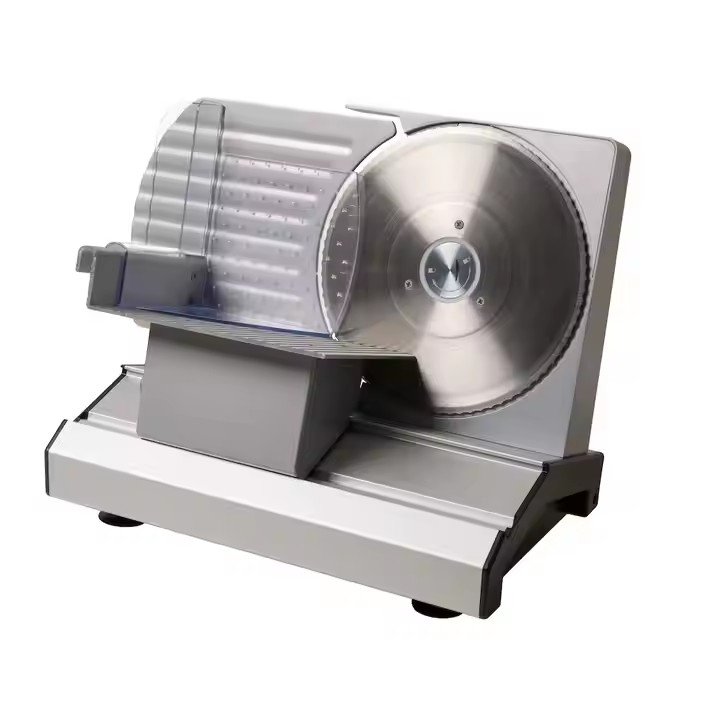
A professional commercial food slicer should provide stable cutting performance, dependable thickness adjustment and a housing that resists movement during operation. For example, the AIMA MS-2202 uses a 220W motor, a gear-driven transmission, a 220mm stainless steel blade and a heavy-duty cast iron housing. The thickness adjustment range is 0–20mm, which gives buyers a practical specification for different meat, cheese and food-processing applications.
AIMA Electrical has more than 15 years of focused kitchen appliance manufacturing experience. The company operates a 3,000-square-meter factory in Xiaolan, Zhongshan, Guangdong, with ISO 9001 quality management and 5S production practices. As a result, buyers can evaluate both the product specification and the production system behind it.
What Makes a Commercial Food Slicer Different from a Consumer Model?
Consumer slicers are normally designed for occasional household use. In contrast, commercial equipment must handle higher operating frequency, larger workloads and stricter consistency requirements. Buyers should therefore compare the drive system, blade diameter, frame construction, adjustment mechanism and service requirements.
Drive system and motor output
The motor and transmission determine how efficiently power reaches the blade. A gear-driven system can provide stronger torque than a lightweight belt system, especially when the machine processes denser or chilled food. However, buyers should still confirm the intended application, duty cycle and maintenance instructions before selecting a model.
Blade diameter and thickness control
Blade size affects the usable cutting area and product capacity. A 220mm blade, equal to approximately 8.7 inches, is suitable for buyers seeking a larger commercial format. Meanwhile, the 190mm and 170mm options can help distributors offer a more compact or entry-level product range.
Precise thickness control is also important. A 0–20mm adjustment range allows the operator to select thin slices for deli products or thicker cuts for food preparation. As a result, the buyer should test the adjustment knob, blade guard and carriage movement during sample evaluation.
Housing material and stability
Cast iron and cast aluminum provide a stronger structure than thin decorative plastic. Cast iron generally offers greater weight and stability, whereas cast aluminum can reduce product weight and support easier handling. In practice, the correct choice depends on the customer segment, target price and expected operating environment.
Which Commercial Food Slicer Model Fits Your Product Line?
A strong wholesale range normally includes several blade sizes and housing options. Therefore, distributors can serve different customer budgets without changing suppliers. The following table summarizes AIMA food slicer models listed in the current product portfolio.
| Model | Blade | Power | Housing | Main Positioning |
|---|---|---|---|---|
| MS-2203 | 220mm / 8.7″ | 220W | Cast iron | Heavy-duty gear-driven |
| MS-2202 | 220mm / 8.7″ | 220W | Cast iron | Heavy-duty gear-driven |
| MS-2201 | 220mm / 8.7″ | 220W | Cast aluminum | Electric gear-driven |
| MS-1909 | 190mm / 7.5″ | 220W | Cast iron | Compact heavy-duty model |
| MS-1701 | 170mm / 6.7″ | Not specified | Cast aluminum | Commercial entry model |
If the buyer prioritizes stability and a larger blade, a 220mm cast iron model is a suitable starting point. If lower product weight matters more, a cast aluminum model may be preferable. Alternatively, a 170mm or 190mm model can support retailers that need a compact product for smaller commercial kitchens.
Before confirming a purchase, request the full technical data sheet, product drawings, packaging dimensions and loading quantity. Additionally, ask whether the supplier can provide 120V, 220–240V, 50Hz and 60Hz configurations for the intended sales market.
What Certifications Should Buyers Request for Export Markets?
Certification requirements vary by destination, product configuration and sales channel. Nevertheless, buyers should confirm compliance before production begins. A certificate issued for one electrical version may not automatically cover another voltage, plug or component configuration.
| Requirement | Why It Matters | Buyer Action |
|---|---|---|
| CE | Supports access to applicable European markets. | Confirm LVD and EMC documentation for the exact model. |
| IECEE CB Scheme | Helps support international electrical safety recognition. | Request the CB certificate and corresponding test report. |
| RoHS | Addresses restricted substances in electrical products. | Verify component and material declarations. |
| UL readiness | May support future North American certification work. | Confirm whether the design and components are prepared for UL review. |
| IEC 60335-1 | Provides a reference for household and similar electrical appliance safety. | Ask which applicable product standard was used in testing. |
In addition to certificates, request the product label artwork, user manual, wiring diagram, test records and packaging marks. For food-contact areas, buyers should also clarify the blade material and cleaning instructions. Consequently, compliance review becomes part of the purchase process rather than a last-minute document request.
AIMA lists CE, CB, RoHS and UL-ready capability within its factory information. Buyers should still confirm the exact certificate scope, test laboratory and electrical configuration for every purchase order.
Why Source a Commercial Food Slicer from a Professional B2B Factory?
A factory-direct relationship can improve communication across engineering, production, quality control and logistics. In contrast, a trading-only supplier may need to request technical answers from another organization. That extra communication layer can delay sample approval or make specification changes harder to track.
Four factors to compare before placing an order
- Manufacturing continuity: Check the supplier’s years of focused experience, factory location and product specialization.
- Technical transparency: Request motor details, blade dimensions, housing material, electrical options and packaging data.
- Quality process: Confirm incoming inspection, production inspection, final inspection and safety testing.
- Commercial support: Compare OEM/ODM options, communication speed, documentation and container planning.
AIMA operates under the AIMA and OTOJIA brand structure. AIMA represents the industrial manufacturing entity, while OTOJIA is used for international trademark and distribution activities. Both brands connect buyers with the same production source. Therefore, importers can discuss private labeling, packaging and product configuration directly with the factory team.
The factory is located at No. 1 Wenxian Road, Dongsheng Area, Xiaolan Town, Zhongshan City, Guangdong, China. It has also presented commercial kitchen equipment at HOTELEX Shanghai 2026, Booth 2.2B15. These details give buyers practical points for supplier verification and business communication.
What OEM and ODM Options Are Available?
OEM and ODM projects work best when the buyer separates essential changes from optional upgrades. For example, voltage and plug type may be mandatory for market access, while color and packaging may support brand positioning. As a result, the first inquiry should include a clear specification checklist.
- Branding: Logo placement, nameplate design and product markings.
- Packaging: Retail box, master carton, barcode, warning labels and manuals.
- Electrical configuration: 120V 60Hz or 220–240V 50/60Hz options.
- Product appearance: Housing color, finish and selected trim materials.
- Product configuration: Blade size, thickness scale, plug and accessories.
Buyers should approve a pre-production sample before mass production. In addition, the approved sample should be linked to a written specification sheet. That document can identify the motor rating, blade diameter, housing material, control layout, packaging artwork and inspection standard.
For distributors, a tiered product family can be more effective than a single model. A 220mm cast iron model can serve high-volume commercial users, while a cast aluminum or 170mm model can target smaller operators. This approach gives sales teams multiple price points while keeping supplier management more focused.
How Does the Factory Control Commercial Food Slicer Quality?
Product quality depends on repeated inspections rather than one final check. AIMA’s stated quality system includes IQC incoming inspection, production quality control and laboratory testing. Therefore, buyers should ask how inspection records connect to the purchase order and approved sample.
IQC incoming inspection
Incoming quality control checks components before they enter production. Key items may include motors, blades, switches, housings, wiring, fasteners and packaging materials. Early inspection helps prevent one defective component from moving through the entire assembly line.
Assembly and online inspection
During assembly, workers can verify wiring, mechanical movement, blade installation, thickness adjustment and external appearance. Furthermore, an online electrical performance check can identify problems before packing. This process is especially important for products sold under a distributor’s private label.
Laboratory and safety testing
The factory information lists RoHS testing, drop testing, vibration testing, glow-wire testing, ball-pressure testing and leakage-current testing. These tests address different risks, including material compliance, transport durability, heat resistance and electrical safety.
Buyers should request an inspection plan that identifies the sampling level, acceptance criteria and test equipment. In addition, an independent pre-shipment inspection can be arranged when the order value or destination requirements justify the additional control.
How Many Commercial Food Slicers Fit in a 40HQ Container?
Container efficiency affects landed cost, warehouse planning and wholesale margin. However, the final quantity depends on packaging dimensions, loading method and confirmed carton configuration. The following figures are reference data from the product information and should be reconfirmed before shipment.
| Model | 40HQ Reference Quantity | Commercial Consideration |
|---|---|---|
| MS-2202 | 1,380 units | Heavy-duty cast iron and 220mm blade format |
| MS-2201 | Approximately 1,428 units | Cast aluminum housing may support lower shipping weight |
| MS-1909 | Approximately 1,500 units | 190mm compact heavy-duty format |
Ask the supplier to provide carton dimensions, net weight, gross weight, units per carton and pallet information. Next, compare the loading quantity with your forecasted sales volume. If a full container is too large for the first order, discuss a smaller trial order, mixed loading or a staged purchasing plan.
Incoterms, port selection and destination handling also influence total cost. Therefore, a useful quotation should separate product price, packaging, tooling, inland transport and shipping assumptions. Buyers can then compare suppliers using the same cost structure.
What Is the Recommended Procurement Roadmap?
A structured procurement process reduces misunderstandings and improves launch timing. First, define the target market and customer application. Then, match the required blade size, voltage, housing material and price level to a suitable model.
- Define the market: Identify destination voltage, certification, plug type, customer segment and expected annual volume.
- Shortlist models: Compare blade diameter, motor power, drive system, housing, adjustment range and product dimensions.
- Request samples: Test slicing consistency, noise, stability, cleaning access, blade removal and thickness adjustment.
- Approve documents: Confirm the technical sheet, artwork, certificates, manual, packaging and inspection standard.
- Place the order: Confirm MOQ, production schedule, payment terms, shipping terms and final loading quantity.
- Complete inspection: Review production samples or arrange pre-shipment inspection before balance payment and shipment.
In summary, the right commercial food slicer is the model that matches application, compliance, serviceability and container economics. A lower-priced model may be useful for an entry range, whereas a heavier cast iron model may provide stronger value for intensive commercial use. The best decision comes from comparing the complete supply package rather than one specification alone.
Commercial Food Slicer FAQ
What blade size should a wholesale buyer choose?
A 220mm blade is suitable for buyers seeking a larger commercial format and higher working capacity. A 190mm or 170mm blade can be more appropriate for compact kitchens, entry-level ranges or customers with lower daily volume. The final choice should also consider housing stability, product dimensions and target retail price.
Is a gear-driven food slicer better for commercial use?
A gear-driven design can provide strong torque and stable power transmission. Consequently, it may be suitable for more demanding commercial applications. Buyers should still evaluate the motor rating, maintenance requirements, intended food type and supplier’s testing documentation before making a final decision.
Can the AIMA food slicers support OEM orders?
Yes. AIMA provides OEM/ODM support for electrical configuration, branding, packaging, appearance and selected product details. Buyers should submit a written specification, approve a sample and confirm the certificate scope before mass production.
What thickness range does the MS-2202 provide?
The MS-2202 uses a precision adjustment knob with a stated thickness range of 0–20mm. Buyers should test the actual adjustment and cutting result with their target product during sample approval.
How many MS-2202 units can fit in a 40HQ container?
The reference loading quantity for the MS-2202 is approximately 1,380 units per 40HQ container. The confirmed quantity may change according to packaging, pallet use, carton dimensions and loading method, so it should be verified on the final quotation.
Which documents should be requested before shipment?
Buyers should request the commercial invoice, packing list, certificate documents, test reports, user manual, product label artwork, technical specification and inspection record. Depending on the market, additional customs or electrical compliance documents may also be required.
Request a Commercial Food Slicer Quotation
Share your target market, voltage, blade size, branding requirements and estimated order quantity with the AIMA factory team. We can help you compare suitable models for wholesale, distribution and OEM projects.
Email: sales1@zs-aima.com
Phone: 0760-22558182
Ricardo — Marketing & Supply Chain Manager