SASO 2203 Compliance Guide: Sourcing 13A Fused Plugs for Saudi Arabian Commercial Appliances
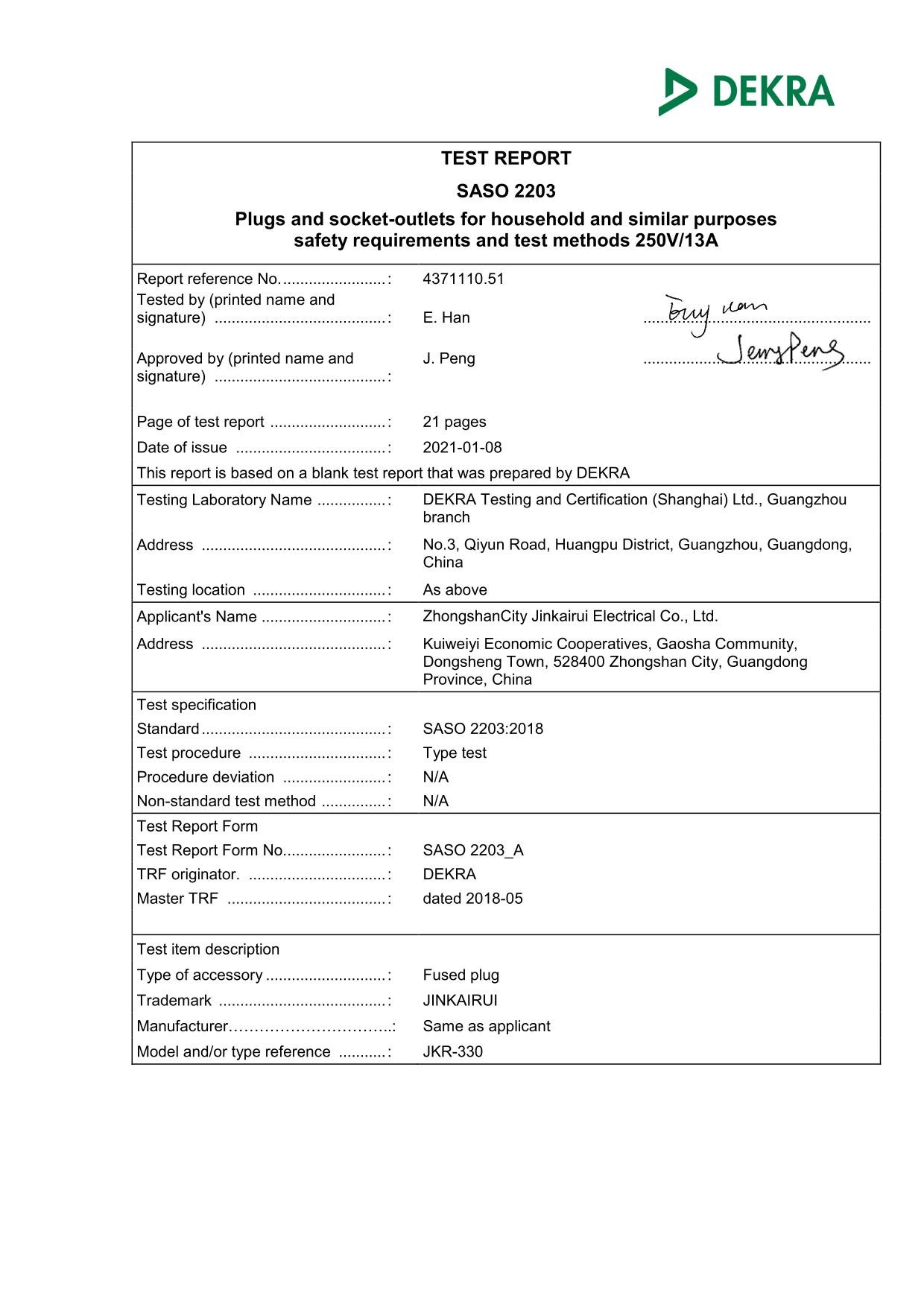
Regulatory Sourcing Executive Summary: Importing commercial kitchen equipment, food slicers, and heavy-duty blenders into the Kingdom of Saudi Arabia (KSA) requires strict compliance with national safety standards. Under the Saudi Standards, Metrology and Quality Organization (SASO) framework, all household and commercial electrical appliances must be equipped with certified 250V/13A fused plugs compliant with SASO 2203:2018. This guide reviews the official DEKRA testing standards for Model JKR-330 (Report No. 4371110.51) and outlines the customs clearance path via the SABER e-portal.
1. Why is SASO 2203 Certification Mandatory for Entering the Saudi Arabian Market?
To safeguard consumers and commercial operations from electrical fires and grid instability, the Saudi Arabian government enforces mandatory compliance for all plug-connected equipment. The SASO 2203 standard establishes rigorous mechanical, electrical, and thermal endurance benchmarks for plugs and socket-outlets. Without an accredited test report and a valid Product Certificate of Conformity (PCoC), shipments arriving at Saudi ports will face severe customs holds or rejection.
2. What Are the Core Technical Specifications of SASO 2203 for 250V/13A Fused Plugs?
The SASO 2203 specification applies to rewireable and non-rewireable 13A fused plugs operating at a nominal voltage of 250V AC and a frequency of 60Hz across Saudi Arabia. Key parameters evaluated during laboratory certification include:
- Rated Voltage & Current: 250V AC / 13A continuous load rating.
- Grid Frequency Compatibility: Engineered specifically for the Saudi 60Hz power grid distribution standard.
- Fuse Link Inclusion: Integrated ceramic cartridge fuse compliant with international safety load breaking capacities.
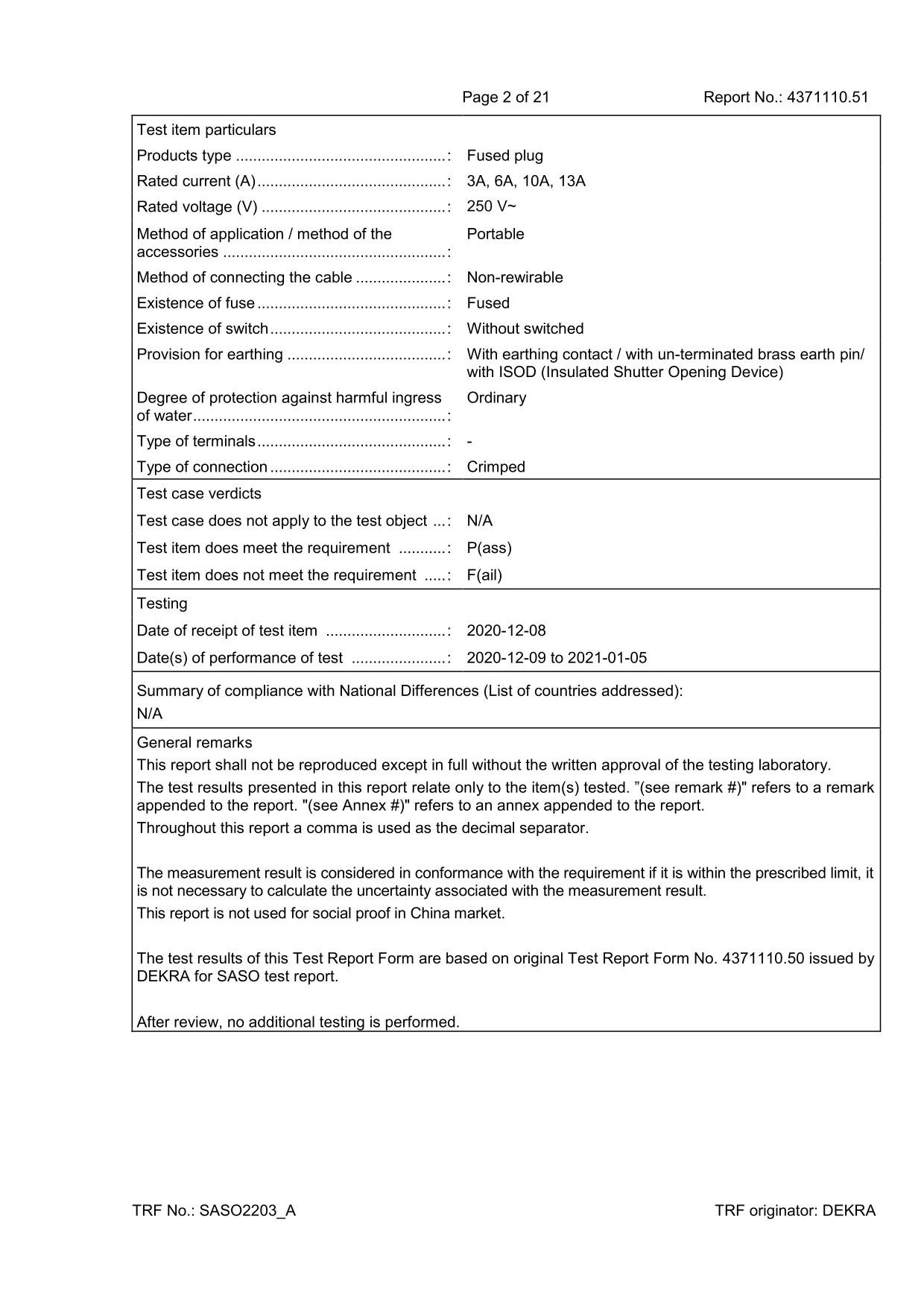
Official DEKRA Laboratory Test Report: Technical General Specifications for Model JKR-330
3. How Does SASO 2203 Align with British Standard BS 1363 (Type G Plugs)?
SASO 2203 is structurally derived from the British Standard BS 1363 (Type G Plug) architecture. The 3-pin rectangular configuration features a solid earth pin that is longer than the live and neutral pins. This ensures that the shutter mechanisms inside the wall socket-outlet are safely opened before the electrical power pins make contact.
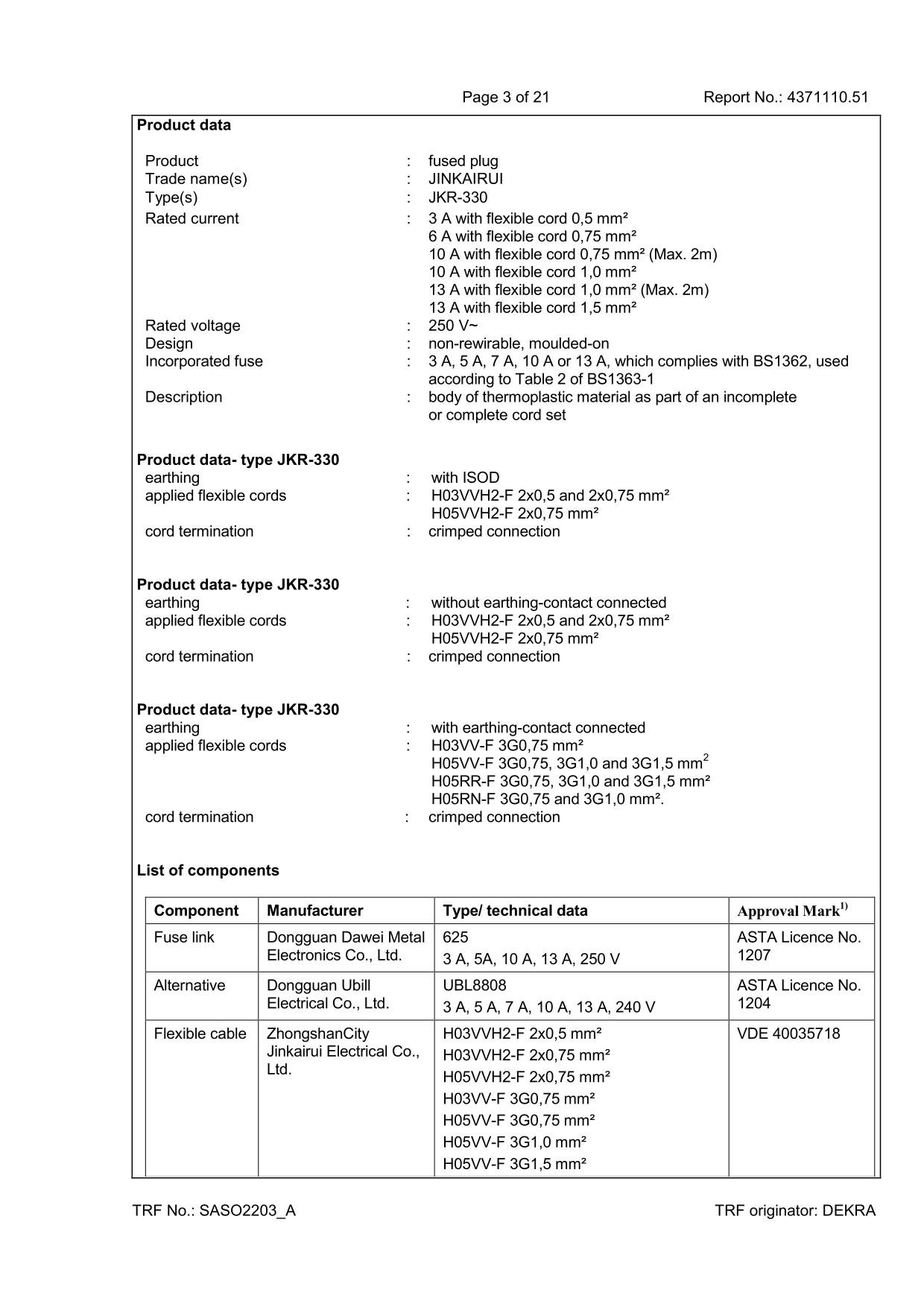
SASO 2203:2018 Safety Requirements Clause Verification Summary Sheet
4. What Laboratory Safety Tests Does DEKRA Conduct for SASO 2203 Certification?
Certification requires rigorous testing by an accredited international testing body such as DEKRA Testing and Certification. Under Report Reference No. 4371110.51, testing covers:
- Temperature Rise Testing: Measuring heat dissipation under a full 13A load to prevent terminal melting.
- Insulation Resistance & Electric Strength: High-voltage Hipot dielectric testing to ensure zero current leakage across plastic housings.
- Mechanical Strength & Drop Impact: Tumbling barrel tests to verify that the plug casing will not crack upon impact.
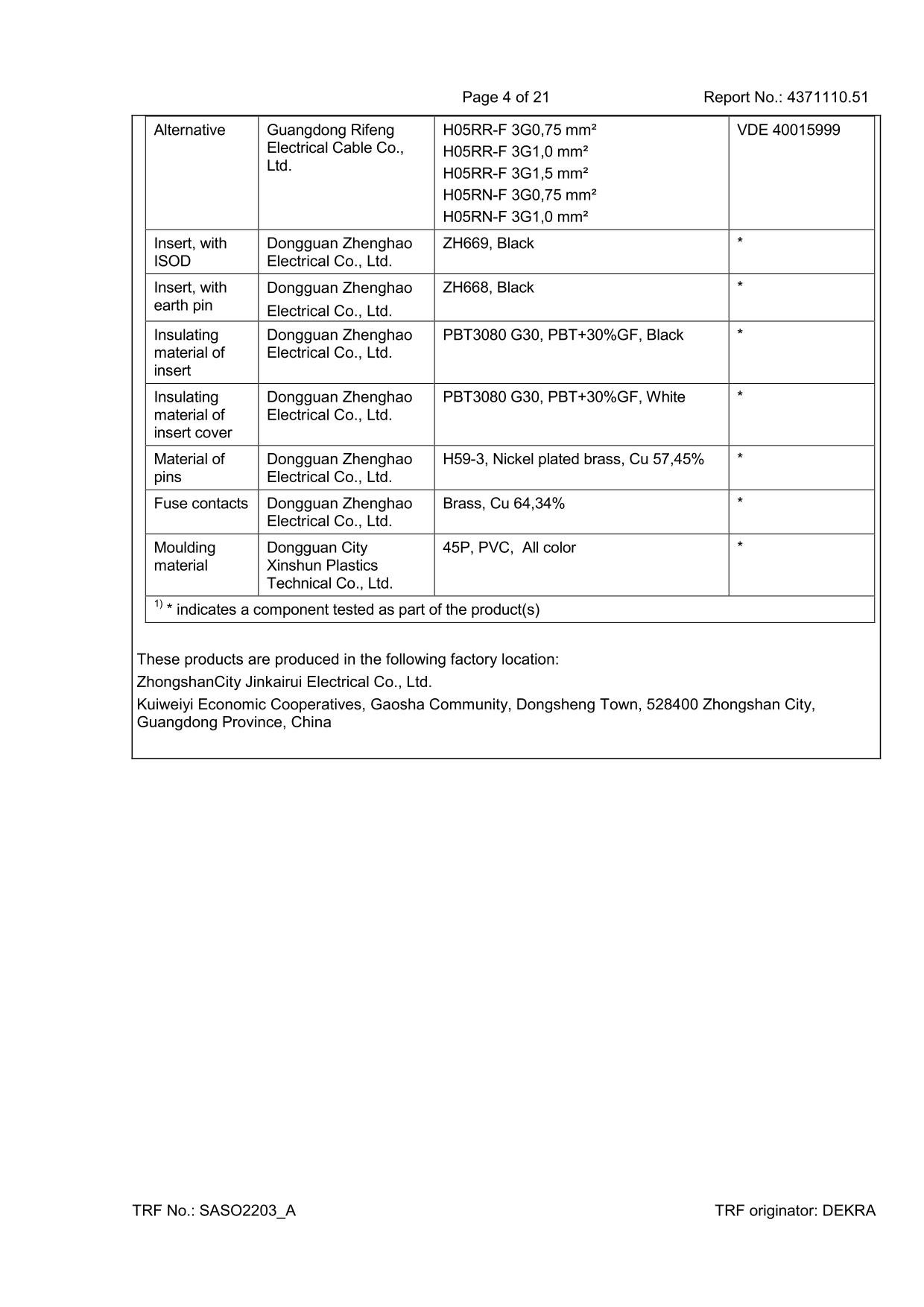
DEKRA Laboratory Test Result Data Sheet verifying compliance across all electrical safety clauses
5. Why Are Built-in Fuse Protection and Fire-Retardant Housings Critical in Saudi Climates?
Due to ambient climate temperatures in the Middle East, commercial kitchen equipment often operates under high heat conditions. Incorporating a standardized BS 1362 ceramic cartridge fuse inside the plug housing ensures instant isolation during overload conditions, protecting commercial blender motors and food slicer electronics from voltage spikes.
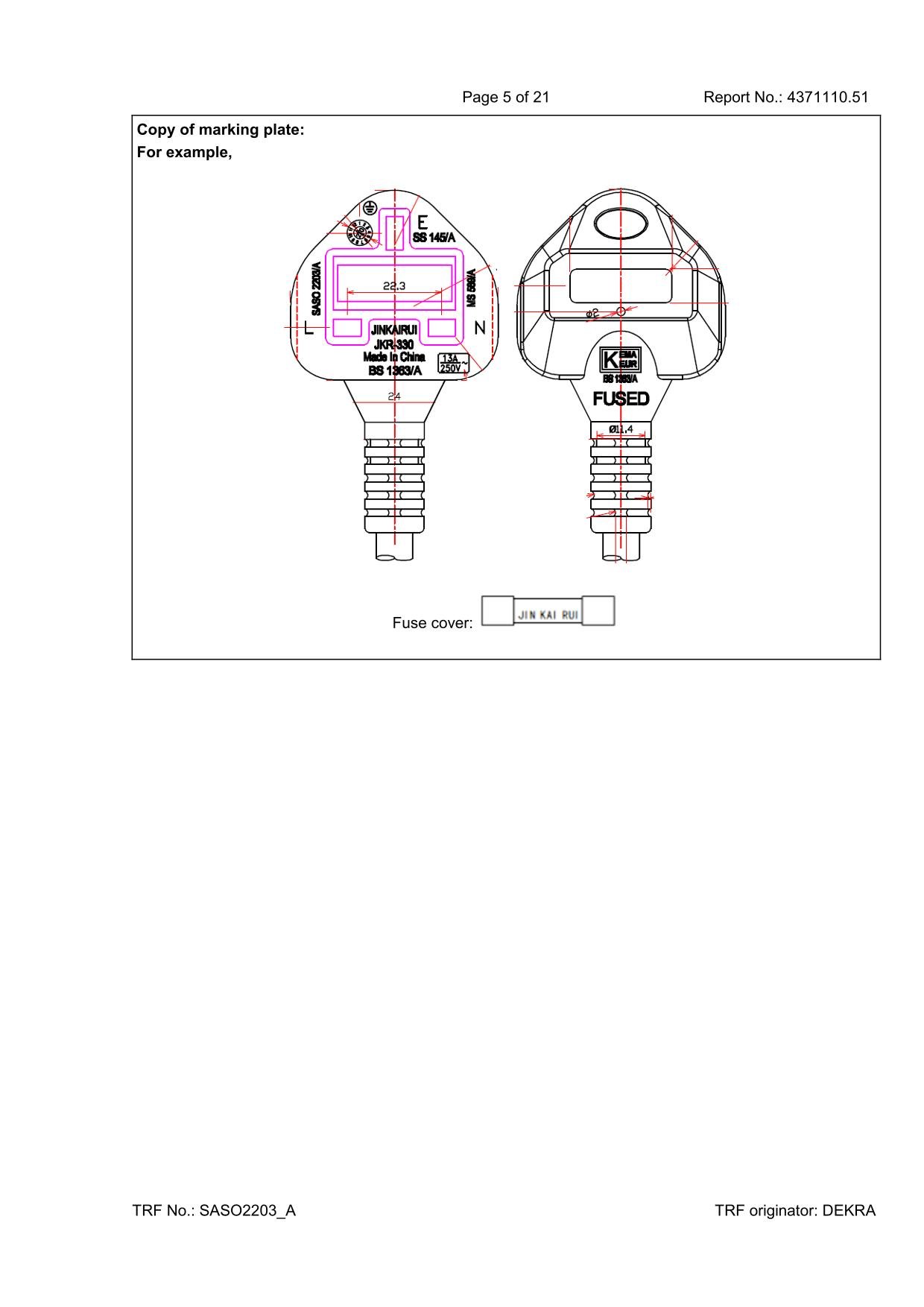
Engineering Specification Line Drawing: Dimensional Parameters for Model JKR-330
6. How Do Product Photo Inspections Verify SASO Compliance for Commercial Appliances?
During factory quality audits, visual inspection plays a key role. DEKRA laboratory reports document the complete physical appearance of the sample, verifying smooth molding edges, clear rating marks, and proper strain relief clamping where the power cord enters the plug base.
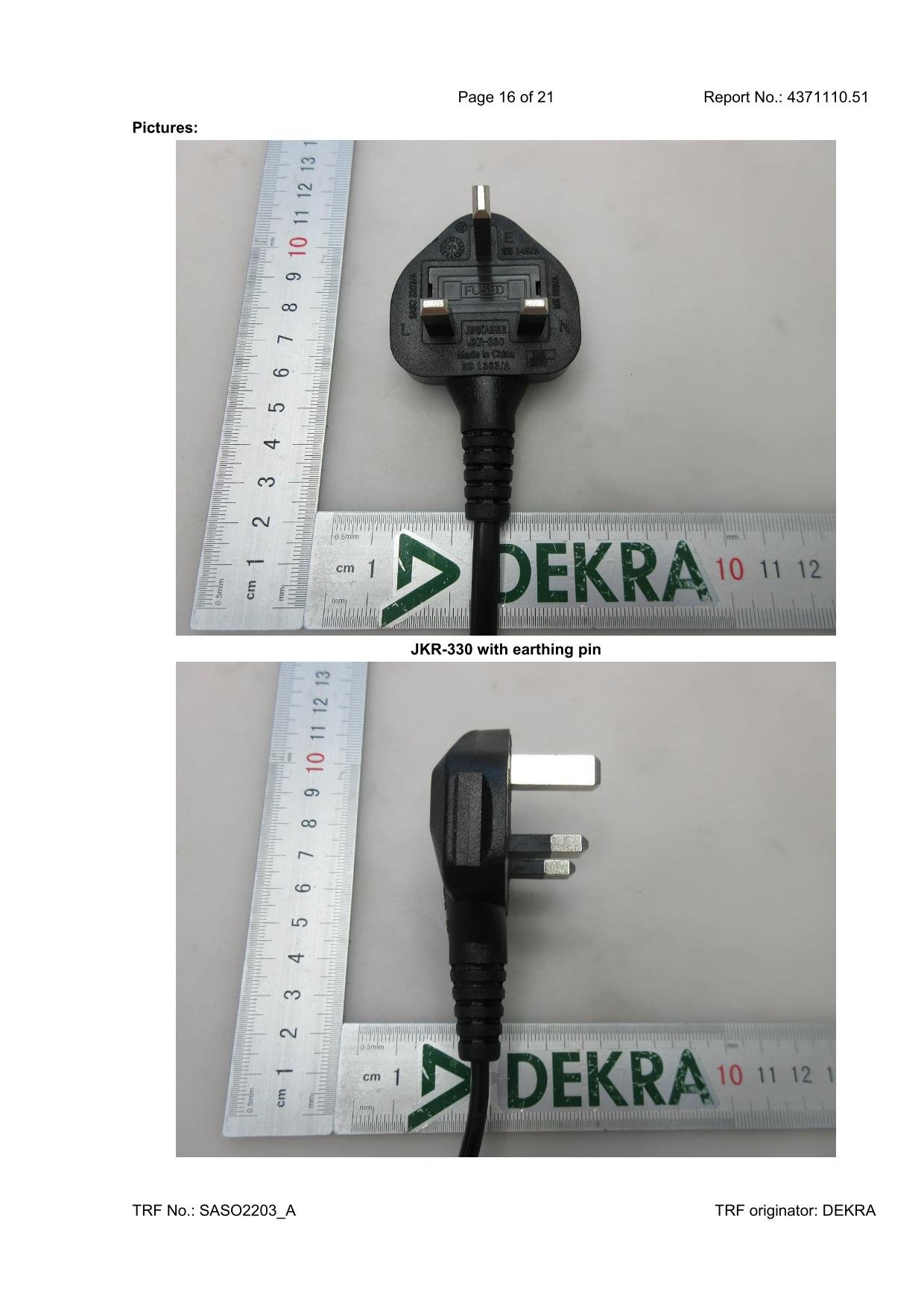
Physical Product Sample Inspection Photo: Front and Profile View of JKR-330 Plug
7. What Are the Mechanical and Insulation Pin Requirements for Saudi 13A Plugs?
A crucial safety feature required by SASO 2203 is the inclusion of insulated sleeves on the live and neutral brass pins. These non-conductive plastic collars prevent accidental human contact with live metal when inserting or withdrawing the plug from a wall socket.
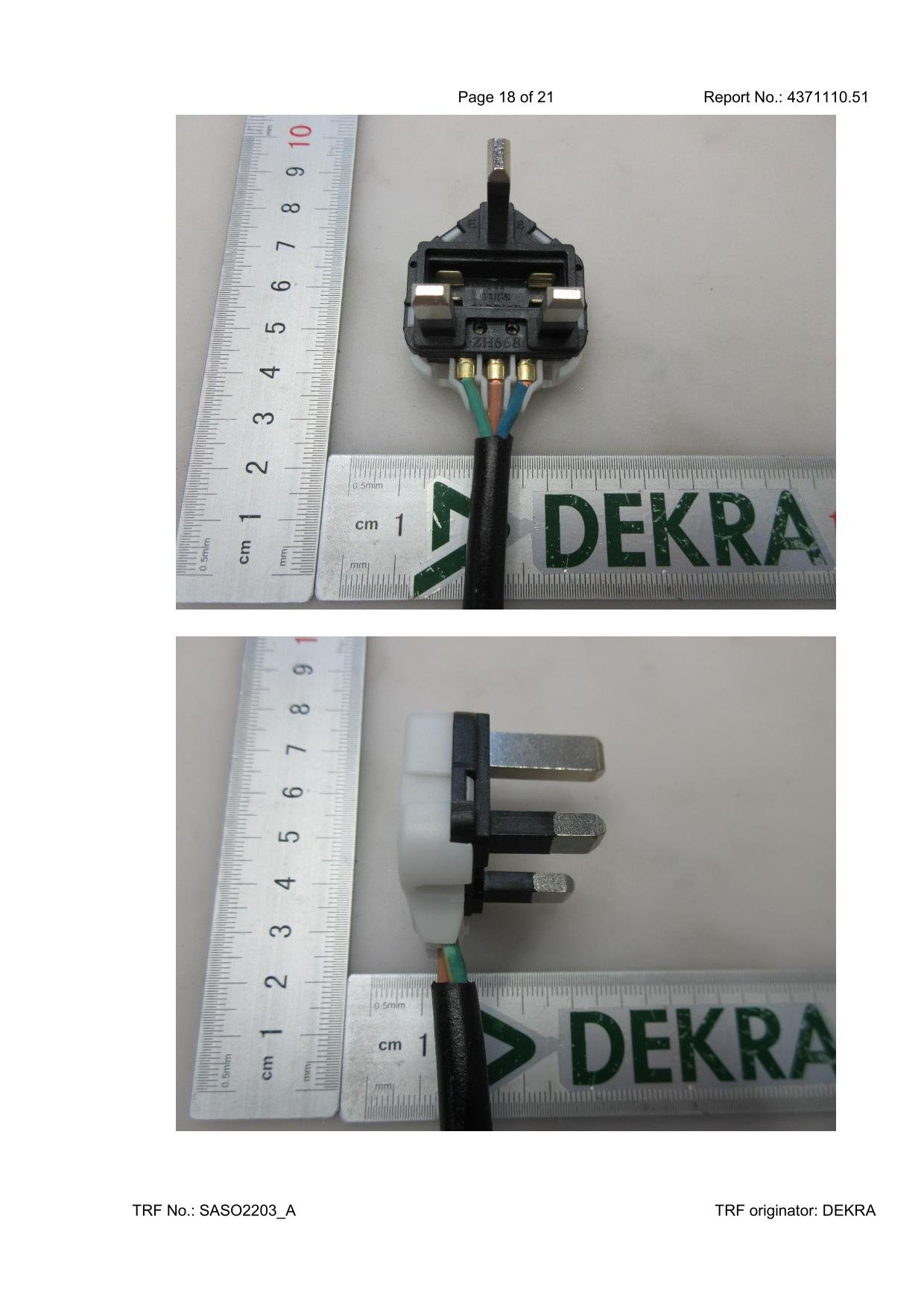
Detailed Pin Inspection Photo: Highlighting Insulated Sleeves and Solid Brass Earth Terminal
8. How Does Internal Fuse Terminal Engineering Prevent Electrical Overloads in Heavy Appliances?
Inside the plug, heavy-duty brass spring clips hold the BS 1362 fuse securely in place. Proper contact pressure is necessary to avoid high contact resistance, which can generate thermal buildup during heavy commercial blending cycles.
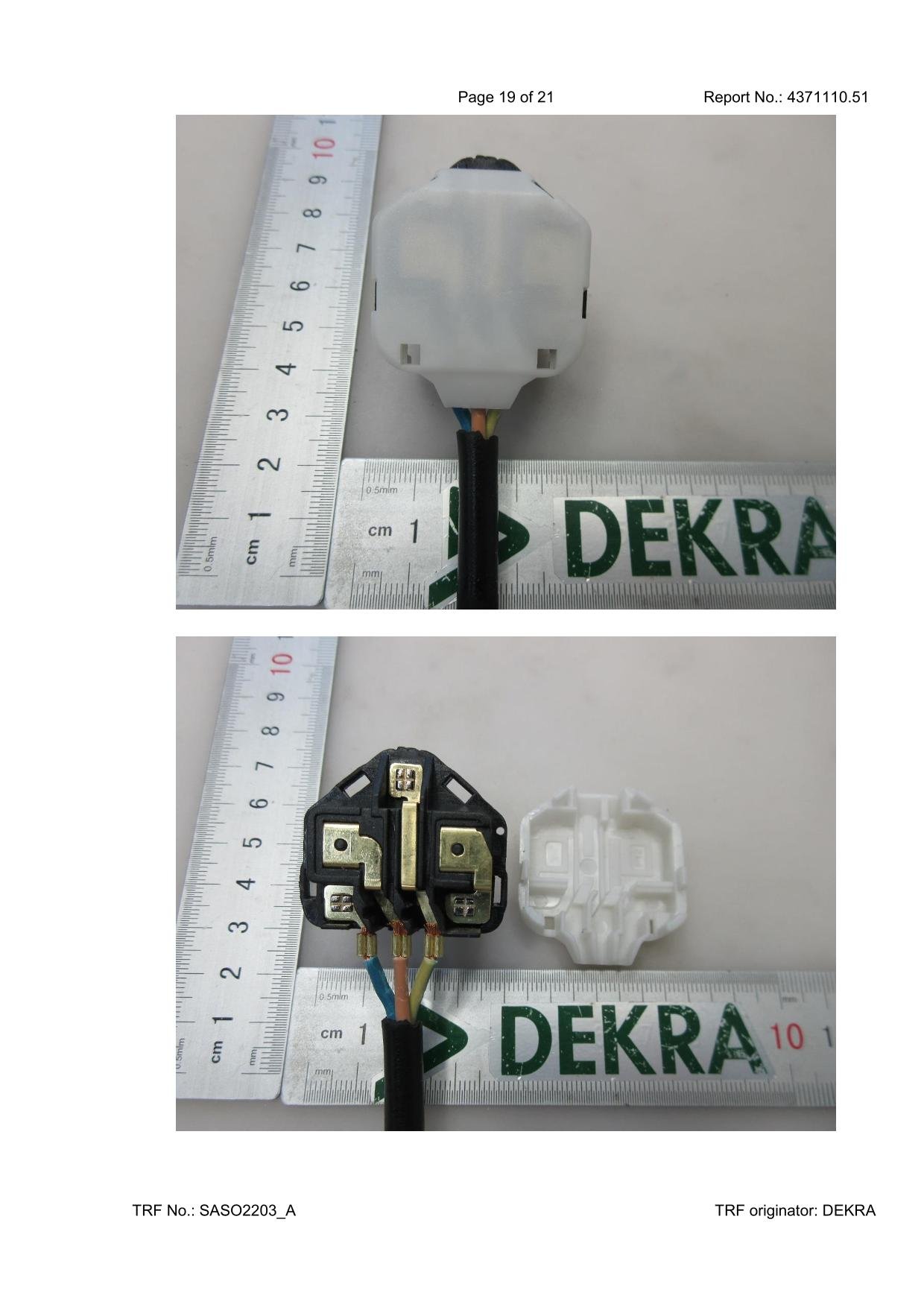
Internal Mechanical Inspection: Heavy-Duty Fuse Carrier Clips and Terminal Screw Contacts
9. What Are the SABER Portal Customs Clearance Rules for Saudi Arabia Importers?
Under the Saudi Product Safety Program (SALEEM), importers must register all regulated products on the online SABER Portal. Obtaining an accredited DEKRA test report for SASO 2203 allows Saudi buyers to quickly generate the mandatory Product Certificate of Conformity (PCoC) and Shipment Certificate of Conformity (SCoC) for hassle-free customs release at Jeddah or Dammam ports.
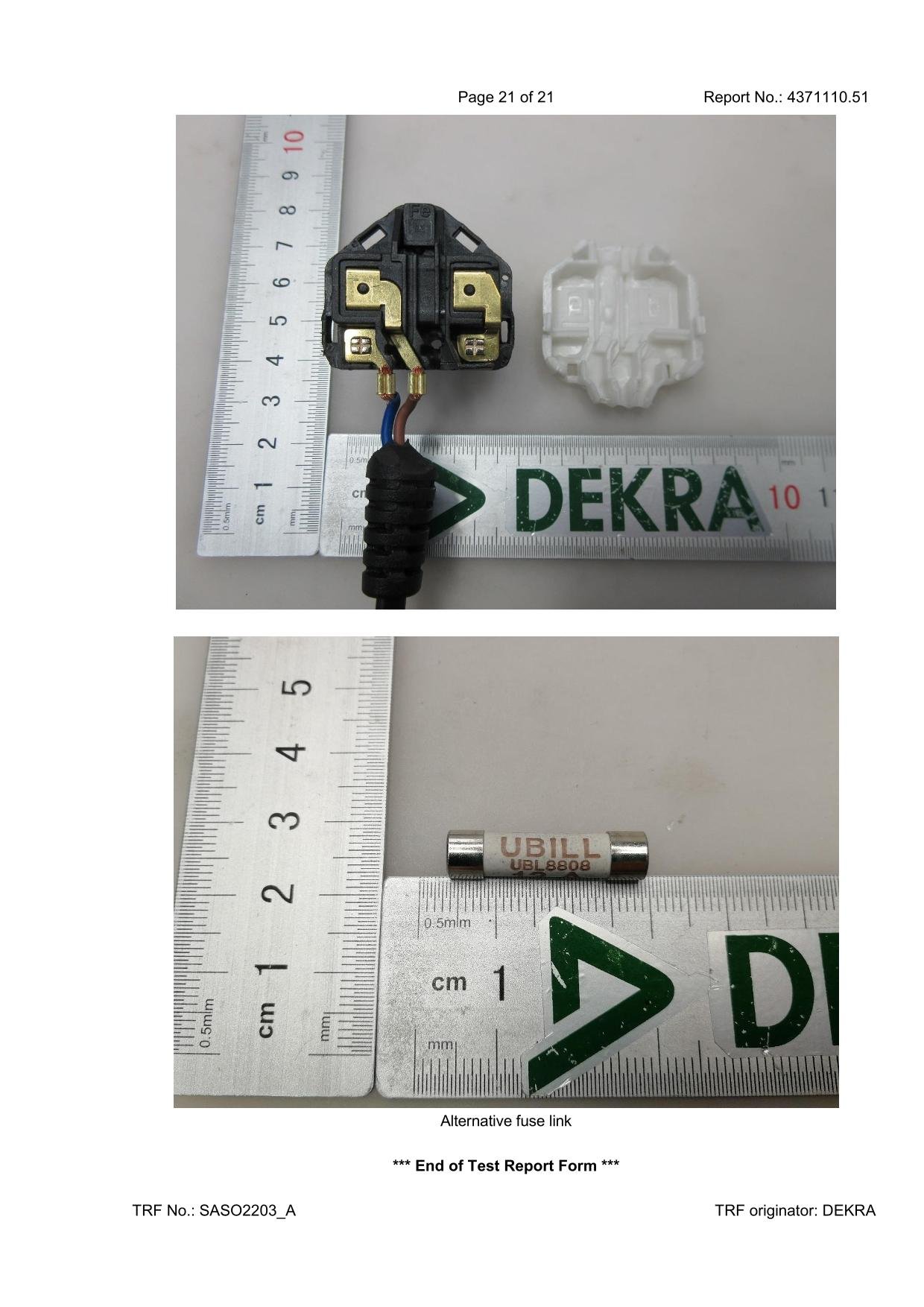
Product Marking & Packaging Inspection: Verified Parameters for Saudi Port Entry
Sourcing SASO-Compliant Commercial Equipment for KSA
Zhongshan AIMA Electrical Appliance Co., Ltd. provides complete OEM/ODM commercial blenders and food slicers fitted with certified SASO 2203 13A plugs for Middle East distributors.
Factory Address: No.1 Wenxian Road, Xiaolan Town, Zhongshan City, Guangdong Province, China
Direct B2B Export Email: sales2@zs-aima.com
VISIT AIMA OFFICIAL WEBSITEFrequently Asked Questions (Saudi Compliance FAQ)
Q1: Is SASO 2203 mandatory for all electrical appliances imported into Saudi Arabia?
Yes, SASO 2203 is the mandatory national standard for 250V/13A plugs used on both household and commercial equipment entering KSA.
Q2: What is the difference between BS 1363 and SASO 2203?
While both define Type G 13A fused plugs, SASO 2203 specifically enforces 60Hz grid compatibility and specialized marking requirements for Saudi customs.
Q3: How does this DEKRA test report assist Saudi importers on the SABER Portal?
An accredited DEKRA test report under SASO 2203 serves as the primary technical document needed to issue a Product Certificate of Conformity (PCoC) on SABER.