Table of Contents
- 1. Deli Counter Duty Cycles in EU Retail
- 2. MS-2202 Parameters and Blade Geometry
- 3. Gear-Driven Transmission and Torque
- 4. Hygiene, HACCP and Cleaning Protocol
- 5. EU Compliance Files for Retail Chains
- 6. Packaging, Logistics and Loading Data
- 7. Factory QC and Workshop Evidence
- 8. Procurement Advice for Deli Programs
- 9. Frequently Asked Questions (FAQ)
1. Deli Counter Duty Cycles in EU Retail
A supermarket deli counter slices continuously between 08:00 and 20:00. During peak hours, staff may cut 60 to 120 portions per hour across ham, salami, roast beef, and cheese.
This pattern destroys light-duty appliances. Specifically, belt-driven slicers lose torque when the blade meets a chilled, dense product. As a result, slices tear, thickness varies, and staff waste product.
Therefore, retail chains specify three performance requirements: constant blade speed under load, repeatable slice thickness, and hygienic disassembly within seconds.
1.1 Product Mix and Blade Load
Cold cooked ham is the most demanding common product, because it compresses instead of cutting cleanly. Additionally, semi-hard cheese creates continuous drag along the blade face.
1.2 Staff Safety Expectations
Retail food safety officers require blade guards, non-slip feet, and clear thickness dials. Moreover, operators rotate between counters, so the machine must be intuitive without long training.
2. MS-2202 Parameters and Blade Geometry
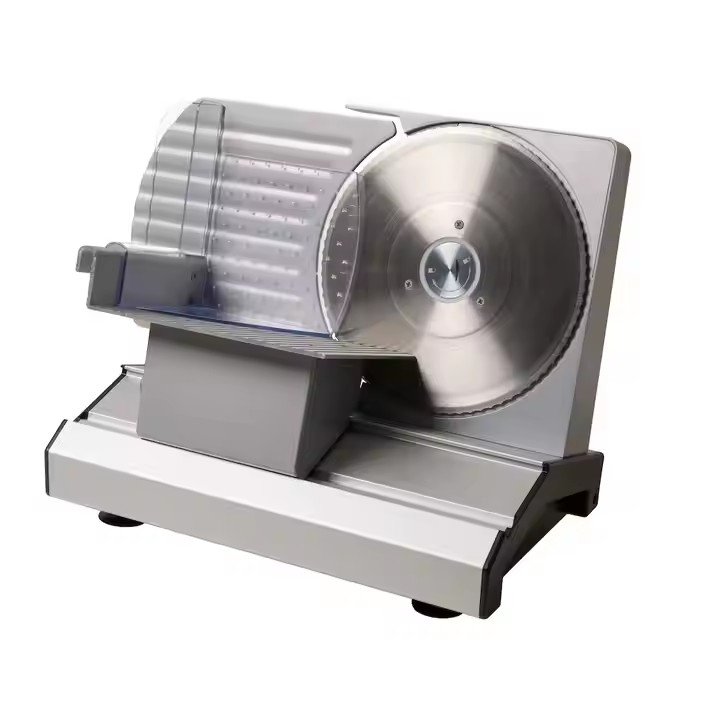
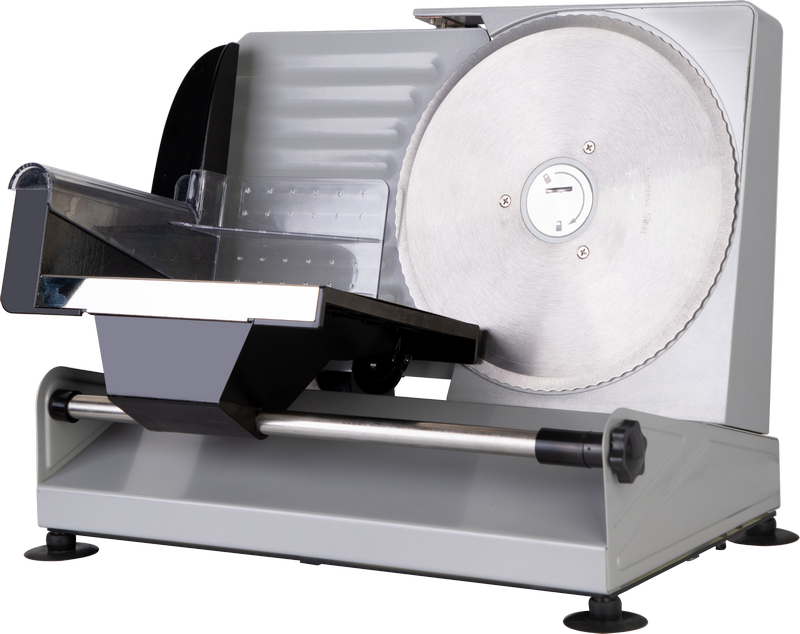
The MS-2202 is a heavy-duty electric food slicer for supermarket deli counters with high daily volume. Furthermore, the same platform supports 170mm, 190mm, and 220mm blade families for smaller formats.
| Parameter | Verified Factory Data (MS-2202) |
|---|---|
| Blade Diameter | 220mm (8.7 inch) German stainless steel |
| Motor Power | 220W pure copper stator, continuous duty rated |
| Transmission | Gear-driven, anti-stall torque transfer |
| Thickness Control | 0-20mm precision knob with positive stops |
| Housing | Black iron casting body with anodised surface |
| Carriage | Removable stainless steel carriage and food holder |
| Voltage | 220-240V 50/60Hz, 110-120V for other markets |
| Plug Options | VDE Schuko, BS 1363 UK, SAA, PSE, US |
| Feet | Non-slip suction rubber feet |
| Loading | 40HQ container: 1,380 pcs with EPS protective packing |
2.1 Blade Sharpening and Edge Life
Blade geometry determines slice quality more than motor power alone. Therefore, AIMA blades are laser cut, hardened, and finished to a consistent bevel.
2.2 Thickness Accuracy
The 0-20mm dial uses a threaded advance mechanism. Consequently, an operator can repeat 1.5mm shaves for sandwiches and 12mm cuts for roasting trays on the same machine.
3. Gear-Driven Transmission and Torque Behaviour
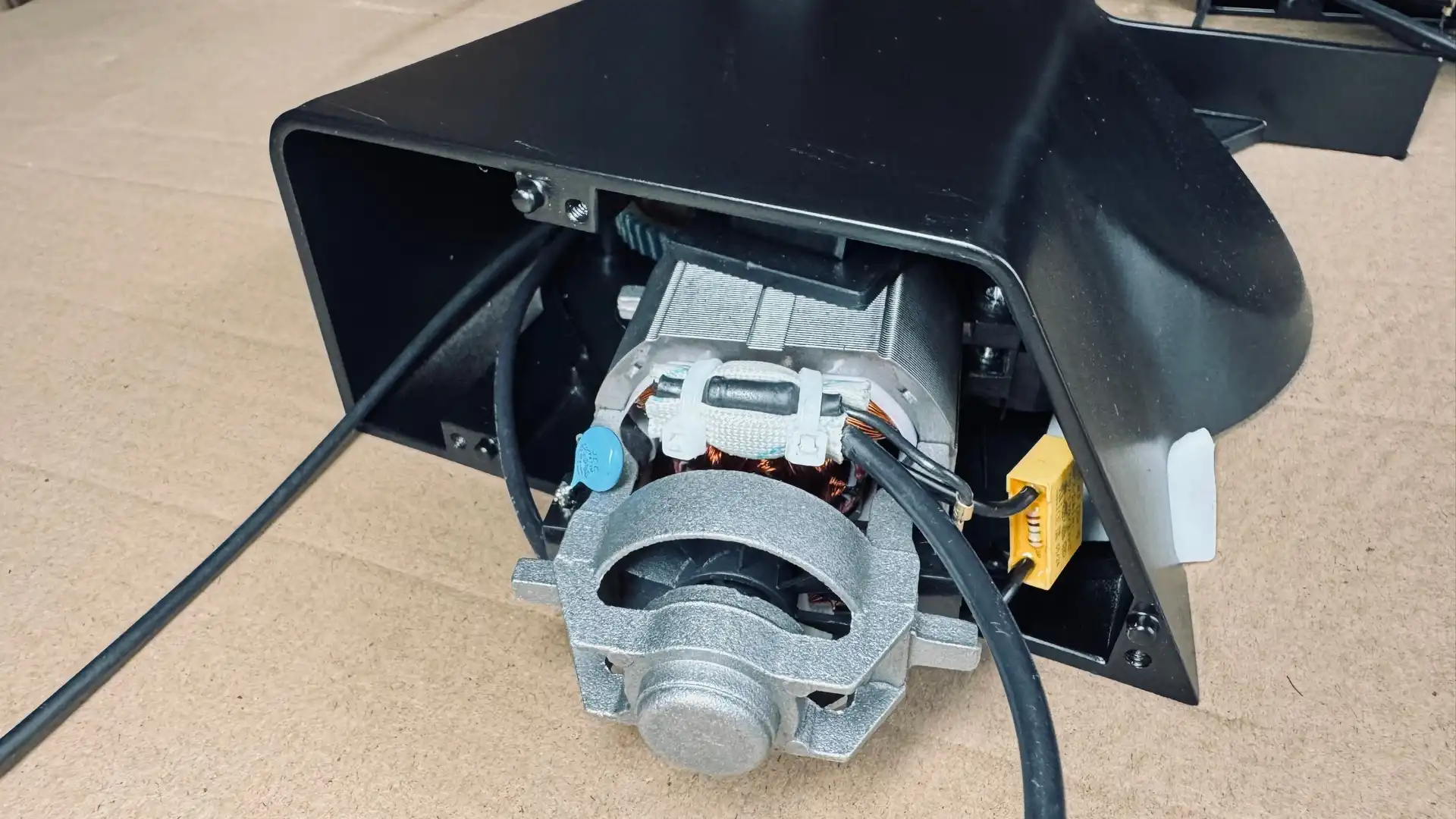
Gear transmission transfers motor force through interlocking metal teeth. In contrast, belt systems depend on friction, which declines as the belt ages and absorbs moisture.
Furthermore, metal gears tolerate the stop-start rhythm of a busy deli counter. Belts stretch under repeated shock loads, and replacement intervals shorten.
3.1 Maintenance Comparison
| Item | Gear-Driven | Belt-Driven |
|---|---|---|
| Torque under cold load | Constant | Reduces with wear |
| Typical service interval | Multi-year | 6-12 months |
| Stall risk on cheese | Low | Moderate to high |
| Fleet spare parts | Blades and knobs | Belts and pulleys |
4. Hygiene, HACCP and Cleaning Protocol
EU food hygiene rules require documented cleaning of equipment that contacts food. The legal framework is published as Regulation (EC) No 852/2004.
Consequently, machine design must expose every food-contact surface. On the MS-2202, the carriage, food holder, and blade guard release without tools.
4.1 Daily Clean-Down Steps
- Switch off, unplug, and set the thickness dial to zero.
- Remove the carriage and wash it in the pot-wash sink.
- Wipe the blade with a damp cloth from the centre outward.
- Dry all parts and record the task in the hygiene log.
4.2 Spare Parts Strategy for Multi-Store Fleets
Chains should hold two blades and one carriage per twenty slicers. This ratio balances emergency response with inventory cost.
5. EU Compliance Files for Retail Chains
Retail groups request paperwork before the first purchase order. Therefore, confirm the document set early in the tender process.
AIMA slicer families are tested to the Low Voltage Directive and the EMC Directive. The reference texts are published in LVD 2014/35/EU and EMC 2014/30/EU.
You can review the certificates that buyers request most often on our AIMA compliance hub, or read the CE LVD and EMC EU sourcing guide.
5.1 Model Family Mapping
Certificates list model families rather than single units. Consequently, always confirm that your SKU appears in the certified model list before listing it for sale.
6. Packaging, Logistics and Loading Data
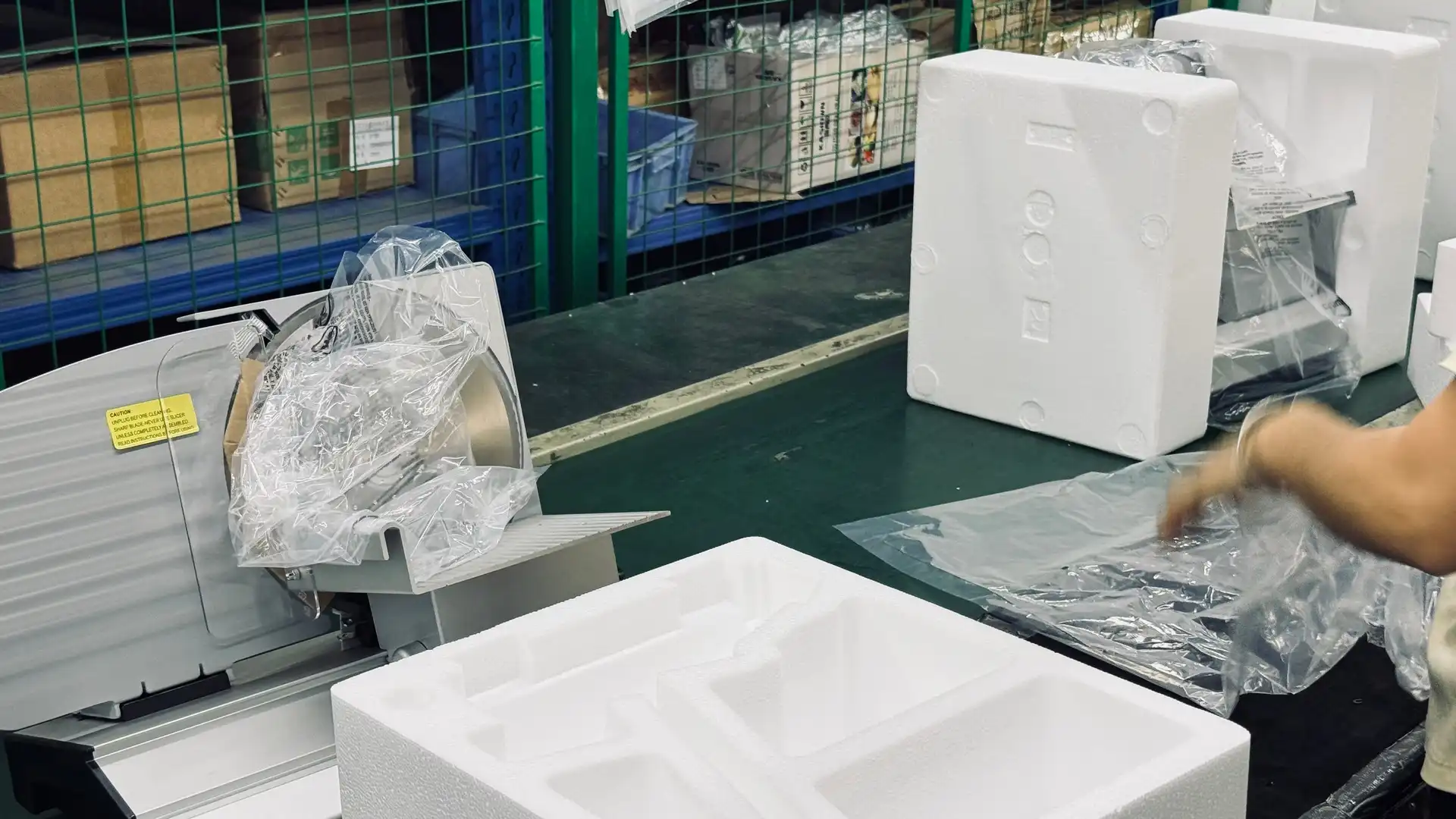
Cast iron slicers are heavy, so packaging protects both the machine and the warehouse team. Therefore, AIMA uses high-density EPS inserts with a five-layer carton.
| Logistics Item | Data |
|---|---|
| 40HQ capacity | 1,380 pcs (standard carton, EPS insert) |
| Pallet pattern | EUR pallet compatible stacking plan |
| Mixed loading | Possible with blender models to balance weight |
| Lead time | 3-4 weeks production after deposit |
| Sample orders | Available for deli pilot trials |
6.1 Pilot Store Rollout
Many chains test twenty to fifty stores first. After that pilot, they release a container order. This sequence validates staff training and spare-part flow before national rollout.
7. Factory QC and Workshop Evidence
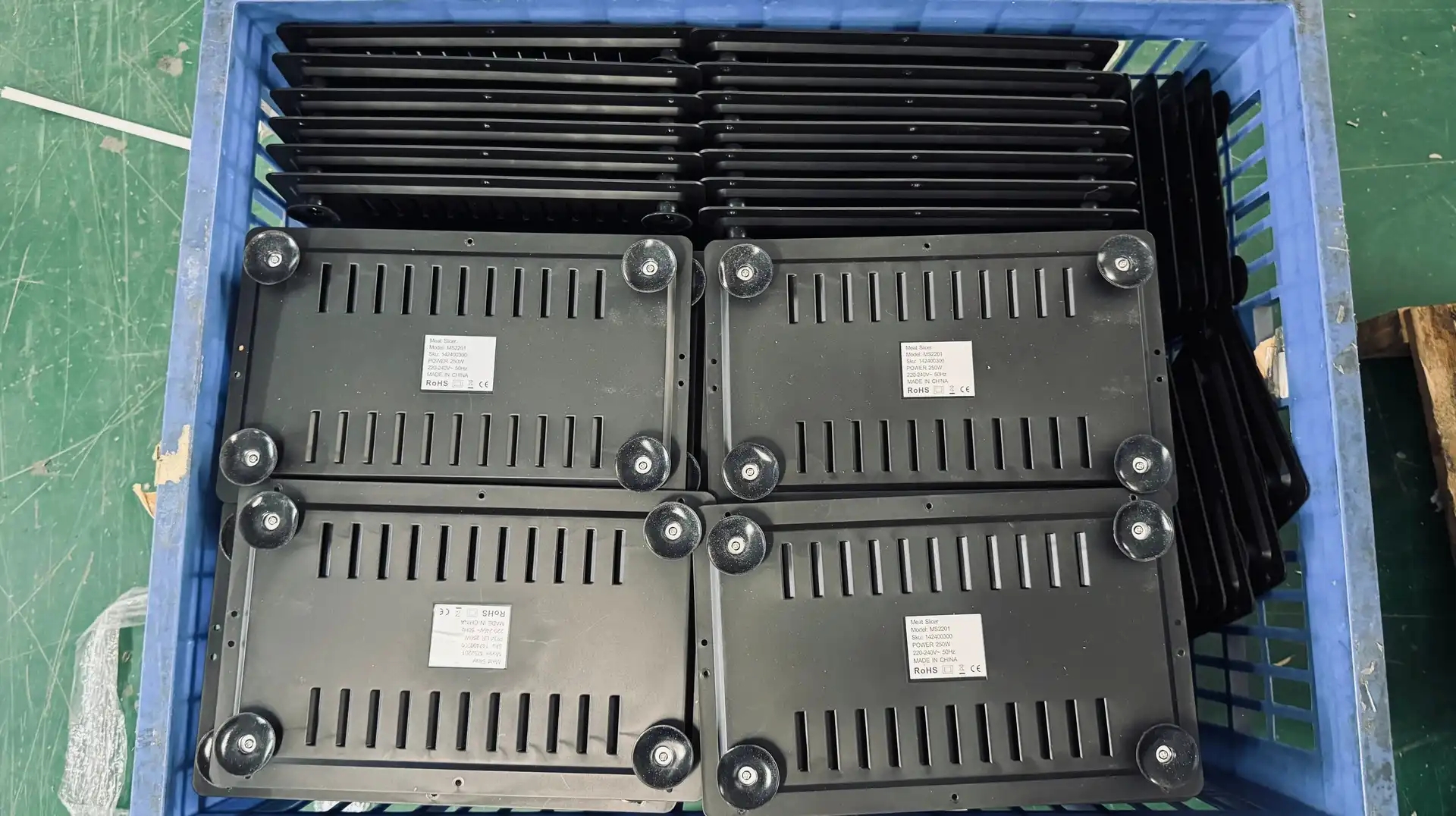
Buyers rarely visit factories before the first order, therefore visual evidence matters. The images below show the actual slicer production line.
7.1 Inspection Points
Each unit passes electrical hipot testing, blade run-out inspection, and a slicing trial on sample product. Additionally, cartons are drop tested before shipment.
8. Procurement Advice for Deli Programs
Deli equipment decisions last five to eight years, so small price differences matter less than serviceability. Therefore, evaluate these points before ordering.
- Blade supply: confirm standard blade availability for at least five years.
- Voltage and plug: match the local socket standard to avoid adapter complaints.
- Housing choice: select cast iron for constant volume, aluminium for light satellite stores.
- Documentation: collect DoC, LVD, EMC, and RoHS files with the first quotation.
- Pilot test: run a two-week trial in one store and measure slice consistency.
Furthermore, request a spare-parts list with your quotation. That list becomes the basis of your fleet maintenance budget.
9. Frequently Asked Questions (FAQ)
Q1: Which blade size suits an electric food slicer for supermarket deli counters?
A: A 220mm blade fits main deli counters with high volume. For satellite stores with limited space, 190mm blades offer the same transmission design in a smaller footprint.
Q2: Is cast iron better than aluminium for deli slicing?
A: Cast iron adds mass and reduces vibration during long shifts. Aluminium housings suit lower volume stores where weight and cost matter more.
Q3: How many units fit in a 40HQ container?
A: The standard configuration loads 1,380 units of the MS-2202 slicer with EPS inserts and master cartons.
Q4: Can blades and carriages be ordered separately?
A: Yes. Chains usually add two blades and one carriage per twenty machines to the first container order.
Q5: Does AIMA provide private label manuals for European retail?
A: Yes. We produce multilingual manuals, branded cartons, and barcode labels for private label programs.
Request Factory Wholesale Quotation
Contact our export team for MS-2202 pricing, blade options, container loading diagrams, and compliance files prepared for EU retail procurement.
Email Our Export TeamDirect Contact: sales2@zs-aima.com