Table of Contents
- 1. Global Regulatory Framework for Commercial Kitchen Appliances
- 2. European Union Access: CE LVD, CE EMC, and RoHS Standards
- 3. International Access: IECEE CB Scheme and IEC 60335-2-14
- 4. Regional Plug and Cable Compliance: VDE, BS 1363, and KEMA-KEUR
- 5. Gulf Region and Japan Standards: SASO 2203, G-Mark, and PSE
- 6. Factory Compliance Testing: 100% In-Line Hipot Protocol
- 7. Container Logistics and Certified Packaging Data
- 8. Frequently Asked Questions (FAQ)
1. Global Regulatory Framework for Commercial Kitchen Appliances
Commercial blenders and electric food slicers operate under demanding conditions, combining high-speed motors, sharp blades, and high electrical current[cite: 2]. Therefore, international customs authorities enforce strict technical standards to ensure user safety and prevent electrical hazards[cite: 2].
Understanding kitchen appliance certification requirements prevents costly shipping delays, port rejections, and inventory seizures[cite: 2]. Specifically, importers must match target market regulations with official test reports issued by accredited third-party laboratories[cite: 2].
Consequently, partnering with an experienced manufacturer like Zhongshan AIMA Electrical Appliance Co., Ltd. ensures full regulatory alignment[cite: 2]. Importers can inspect our complete compliance documentation portfolio on the AIMA official certification hub[cite: 2].
1.1 Electrical Safety vs. Electromagnetic Compatibility
Electrical safety regulations focus on preventing shock, overheating, and mechanical injuries during heavy commercial use[cite: 2]. In contrast, electromagnetic compatibility ensures appliances do not interfere with adjacent wireless networks or electronic systems[cite: 2].
1.2 Importance of Family Testing Models
Certificates frequently group multiple appliance models under a single certified family platform[cite: 2]. Specifically, verifying that your chosen SKU is listed in the official test report ensures complete customs clearance validity[cite: 2].
2. European Union Access: CE LVD, CE EMC, and RoHS Standards
Placing commercial food preparation equipment into European Single Market countries requires mandatory CE marking[cite: 2]. Specifically, appliances must comply with both the Low Voltage Directive (LVD) and the Electromagnetic Compatibility (EMC) Directive[cite: 2].
For additional details regarding European supermarket distribution channels, buyers can review our guide on commercial blenders for supermarket EU chains[cite: 2].
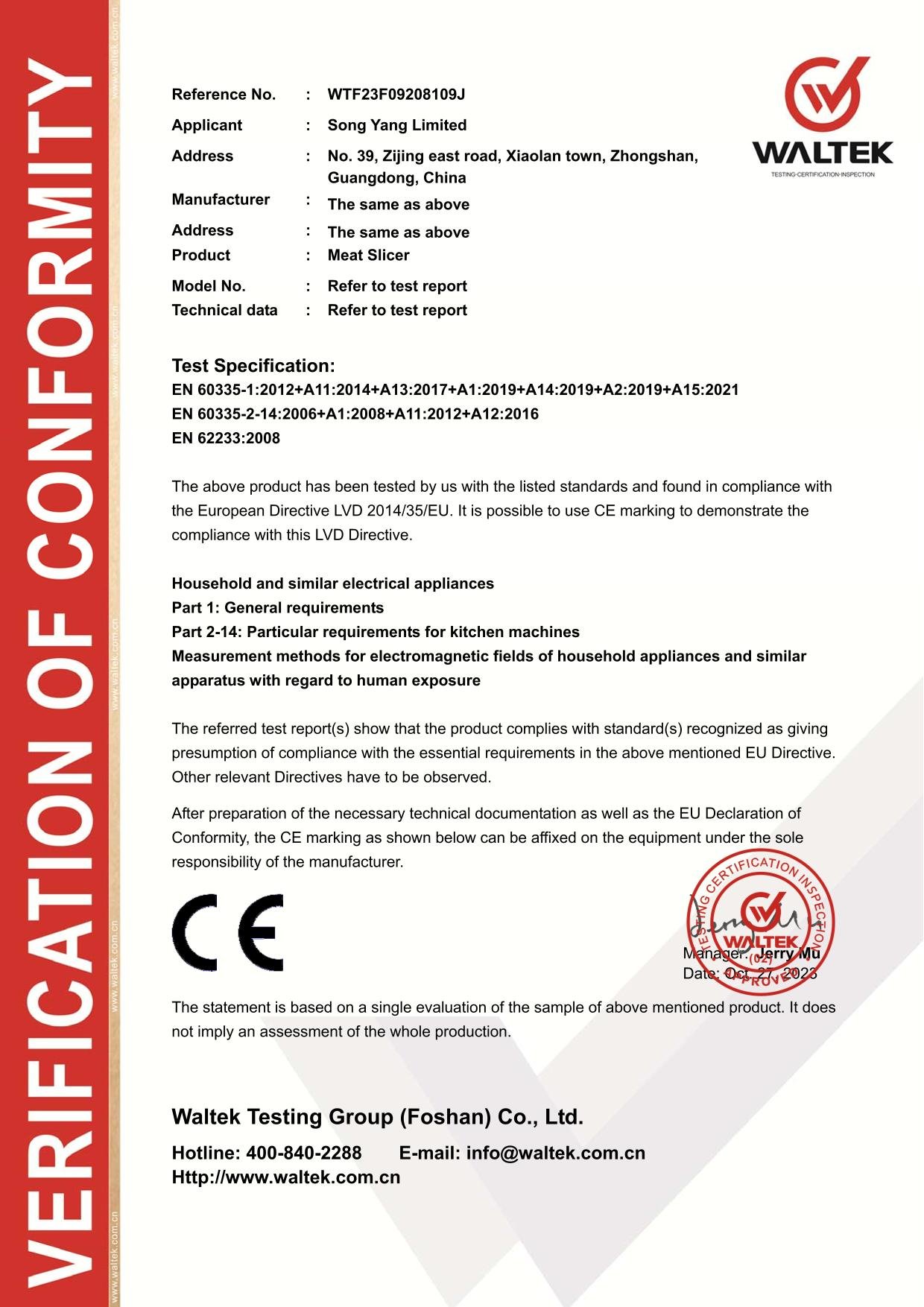
2.1 CE LVD Directive (EN 60335-1 & EN 60335-2-14)
The LVD 2014/35/EU directive covers electrical safety for equipment operating between 50V and 1000V AC[cite: 2]. Standard EN 60335-2-14 applies specifically to electric kitchen machines, testing motor insulation, thermal cut-offs, and blade guard interlocks[cite: 2].
2.2 CE EMC Directive and RoHS Hazardous Substance Controls
EMC standards EN 55014-1 and EN 55014-2 limit harmonic distortion and electromagnetic radiation[cite: 2]. Furthermore, strict RoHS 2011/65/EU compliance guarantees that all internal wiring, circuit boards, and ABS plastics remain free of harmful heavy metals[cite: 2].
3. International Access: IECEE CB Scheme and IEC 60335-2-14
The IECEE CB Scheme facilitates mutual acceptance of electrical safety test reports across more than 50 participating countries[cite: 2]. Therefore, obtaining a CB test certificate dramatically reduces regional certification costs for international importers[cite: 2].
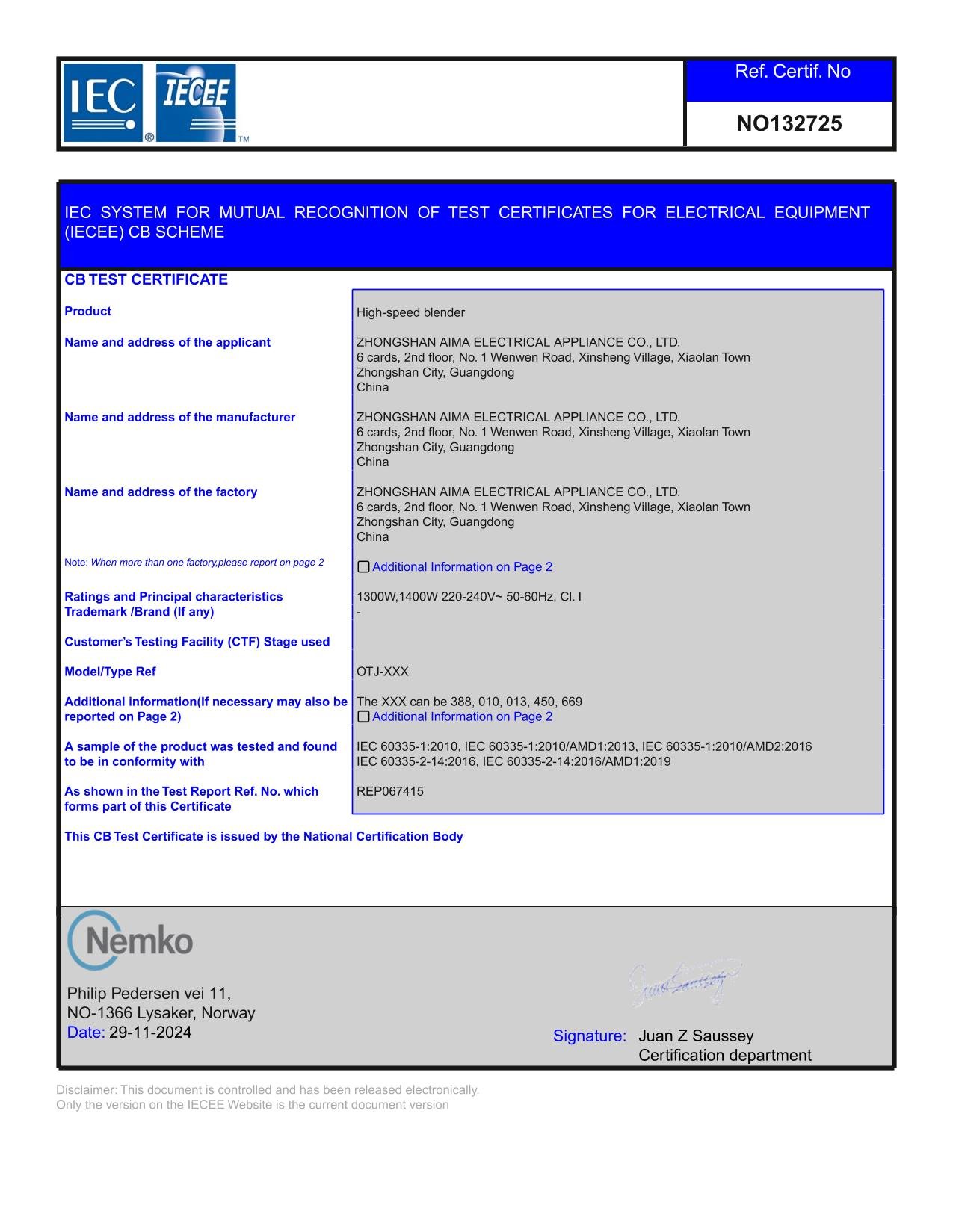
AIMA blenders hold official Nemko-issued CB certificates based on IEC 60335-2-14 international test standards[cite: 2]. Buyers can explore our factory infrastructure on the certified small appliance factory page[cite: 2].
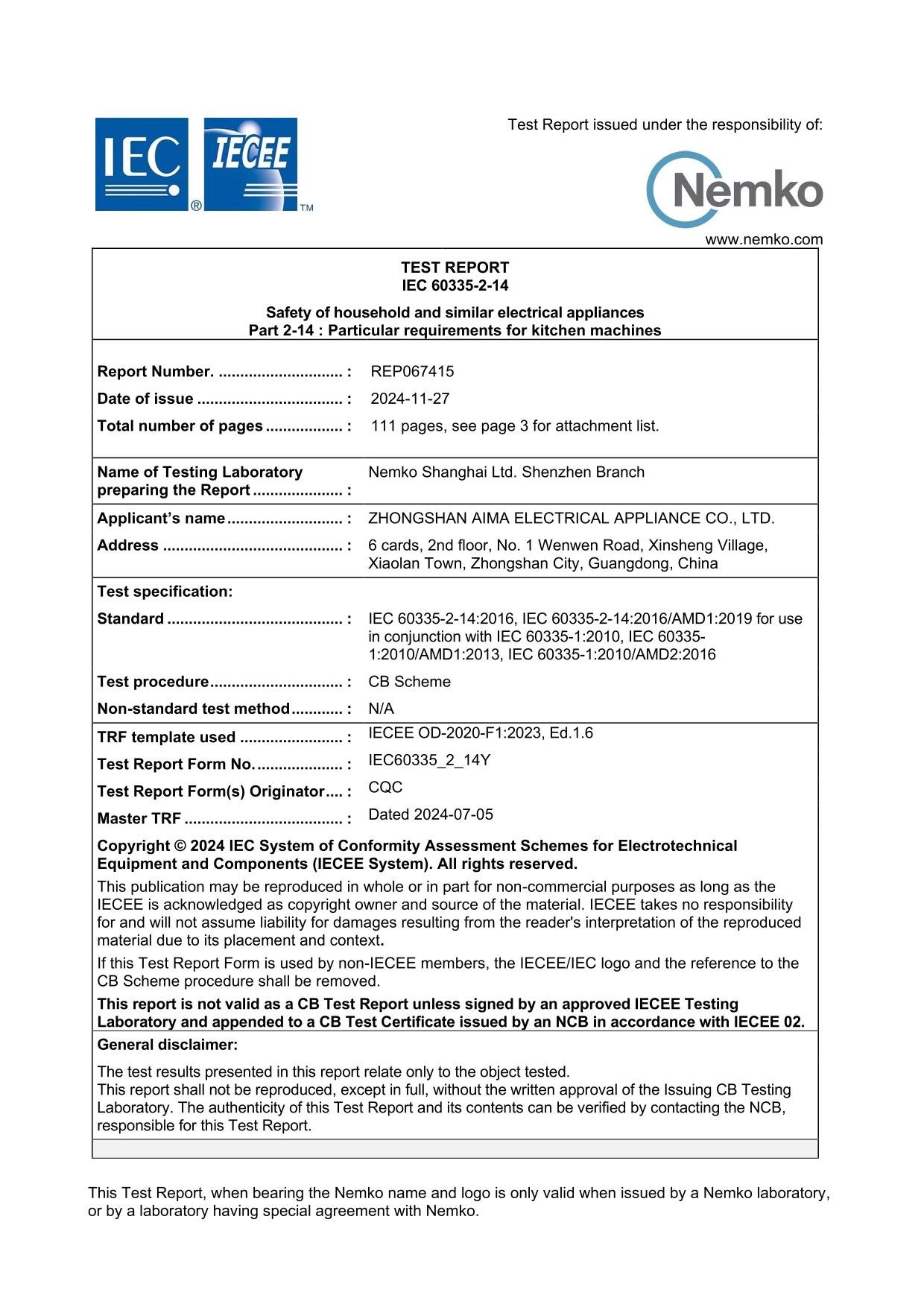
3.1 Nemko CB Certificate NO132725
Nemko certification confirms that AIMA 1500W to 2200W blender motors pass rigorous moisture resistance, mechanical strength, and abnormal operation tests[cite: 2]. Consequently, national certification bodies accept these reports without repeating primary testing[cite: 2].
3.2 Streamlining Multi-Region Distribution
Importers supplying multiple global territories can convert an established CB report into local national marks[cite: 2]. Specifically, this approach accelerates time-to-market while lowering testing expenditures[cite: 2].
4. Regional Plug and Cable Compliance: VDE, BS 1363, and KEMA-KEUR
Electrical safety extends beyond the main housing into power supply cords and molded wall plugs[cite: 2]. Therefore, AIMA equips all export appliances with pre-certified power cables tailored to destination electrical grids[cite: 2].
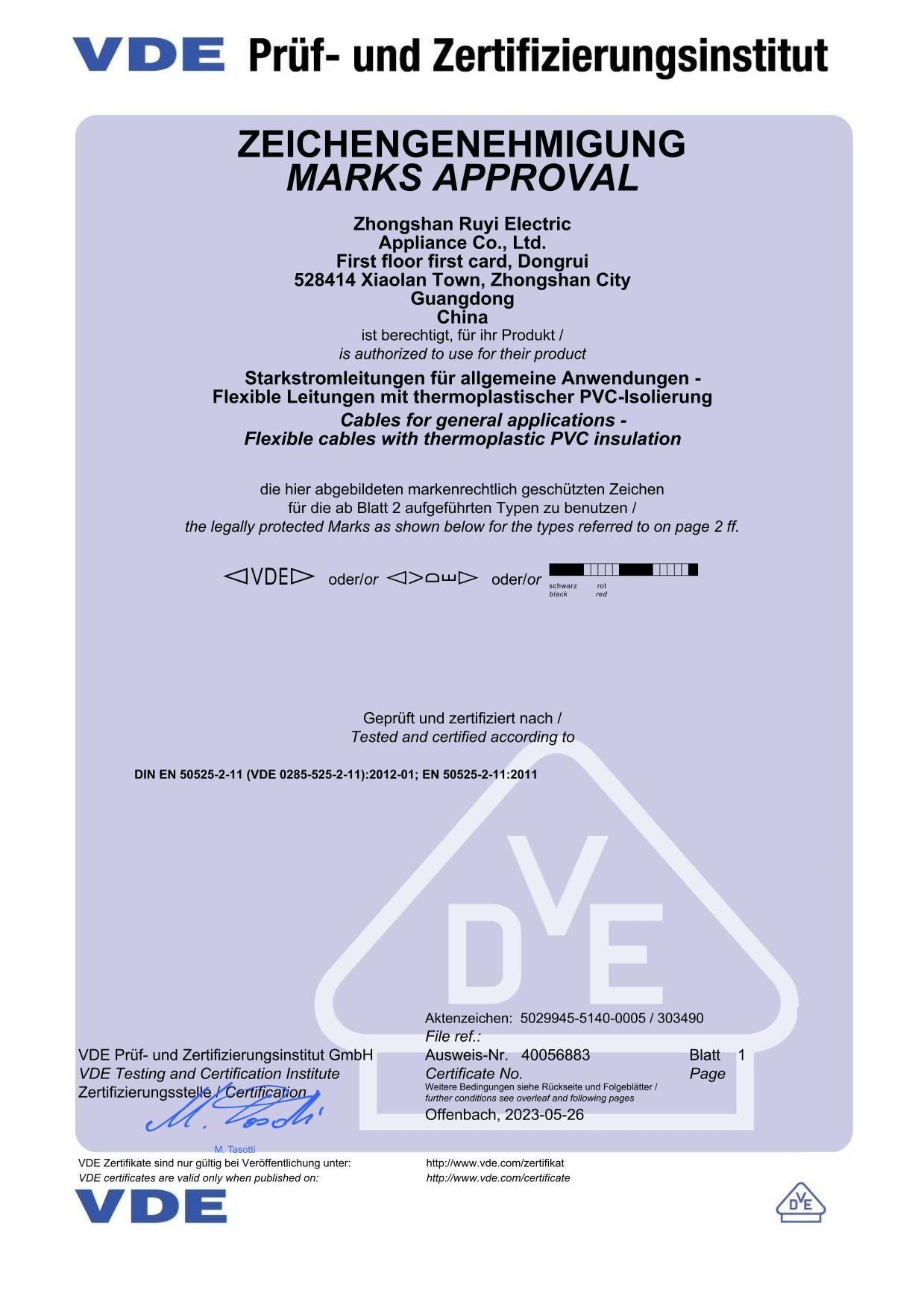
4.1 Continental Europe: VDE Cable and Schuko Plugs
AIMA appliances for Continental Europe use VDE-certified PVC insulated flexible cables compliant with DIN EN 50525-2-11[cite: 2]. Furthermore, molded CEE 7/7 Schuko plugs provide robust dual-grounding protection[cite: 2].
4.2 UK and Ireland: BS 1363 Fused Plugs and KEMA-KEUR
For British and Irish distribution, appliances feature heavy-duty BS 1363 plugs equipped with ASTA or KEMA-KEUR certified internal fuses[cite: 2]. Consequently, commercial kitchens operate safely under continuous heavy electrical loads[cite: 2].
5. Gulf Region and Japan Standards: SASO 2203, G-Mark, and PSE
Exporters serving Middle Eastern and Asian markets encounter unique regional safety mandates[cite: 2]. Therefore, AIMA maintains complete regulatory files covering Gulf Cooperation Council (GCC) member states and Japan[cite: 2].
Importers interested in OEM and private label partnerships can evaluate our guide on private label commercial blender supplier capabilities[cite: 2].
| Target Region / Market | Mandatory Certification / License | Testing Authority & Technical Standard |
|---|---|---|
| European Union (EU) | CE LVD, CE EMC, RoHS Directive[cite: 2] | Waltek / EN 60335-1, EN 60335-2-14[cite: 2] |
| International (IECEE) | IECEE CB Test Certificate[cite: 2] | Nemko / IEC 60335-2-14 Safety Standard[cite: 2] |
| Germany / Europe | VDE Cable License (40056883)[cite: 2] | VDE / DIN EN 50525-2-11 Power Cord[cite: 2] |
| United Kingdom & Ireland | BS 1363 Plug License & KEMA-KEUR[cite: 2] | DEKRA / BS 1363 Safety Standards[cite: 2] |
| Saudi Arabia (KSA) | SASO 2203 Certification File[cite: 2] | DEKRA Tested / SASO Fused Plug Standard[cite: 2] |
| Gulf States (GCC) | G-Mark (GCC Regional Conformity)[cite: 2] | DEKRA / Gulf Technical Regulation[cite: 2] |
| Japan (METI) | Japan PSE Circle & Diamond Mark[cite: 2] | JET / JKR-506 & JKR-205 Licenses[cite: 2] |
5.1 Saudi Arabia SASO 2203 and GCC G-Mark
In the Middle East, appliances must pass DEKRA testing for SASO 2203 fused plugs and G-Mark GCC requirements[cite: 2]. Specifically, these standards verify tropicalized insulation resistance against extreme ambient temperatures[cite: 2].
5.2 Japan PSE Certification (JET JKR-506 & JKR-205)
Japanese electrical appliance imports require PSE approval under the DENAN Act[cite: 2]. AIMA holds official JET licenses covering two-pin (JKR-506) and grounded three-pin (JKR-205) plug configurations for 100V 50/60Hz operations[cite: 2].
6. Factory Compliance Testing: 100% In-Line Hipot Protocol
Paper certificates must be matched by consistent quality execution on the shop floor[cite: 2]. Therefore, AIMA enforces a 100% in-line testing regime across all commercial blender and food slicer assembly lines[cite: 2].
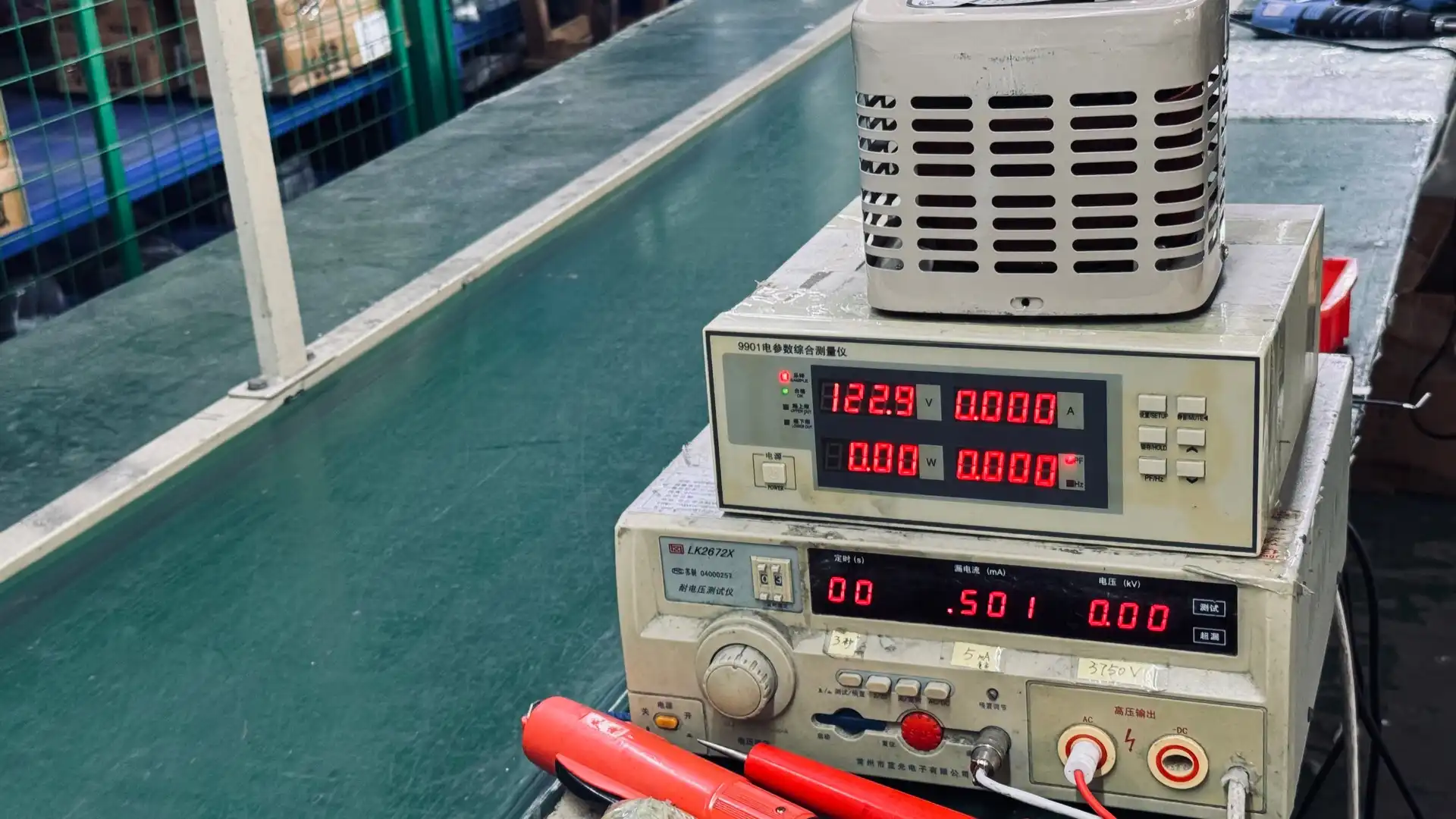
6.1 Dielectric Hipot Insulation Testing
Using Model 9901 electrical parameter analyzers, every assembled unit undergoes high-voltage dielectric breakdown testing[cite: 2]. Specifically, this process detects internal wire chafing or insulation flaws before products are packaged[cite: 2].
6.2 Thermal Protection, Glow-Wire, and Drop Testing
In-house laboratories conduct glow-wire ignition tests on ABS plastic panels, verify motor thermal overload switches, and subject fully packaged cartons to drop and vibration simulations[cite: 2]. Consequently, appliances survive rough ocean transit undamaged[cite: 2].
7. Container Logistics and Certified Packaging Data
Optimizing container packaging design lowers freight costs while protecting certified appliances during sea transport[cite: 2]. Therefore, AIMA utilizes high-density EPS protective foam inserts wrapped inside 5-layer export master cartons[cite: 2].
Importers can review our complete blender collection on the AIMA commercial blenders product page or explore our electric food slicers range[cite: 2].
| Appliance Model & Category | Master Carton Packing | 40HQ Container Capacity |
|---|---|---|
| OTJ-388 / OTJ-388C Commercial Blender | 6 PCS / CTN[cite: 2] | 2,046 PCS[cite: 2] |
| MS-1901 / MS-1905 Food Slicer | 2 PCS / CTN[cite: 2] | 1,852 PCS[cite: 2] |
| MS-1901B Food Slicer | 2 PCS / CTN[cite: 2] | 1,524 PCS[cite: 2] |
| MS-1909 Food Slicer | 2 PCS / CTN[cite: 2] | 1,500 PCS[cite: 2] |
| MS-2201 Electric Meat Slicer | 2 PCS / CTN[cite: 2] | 1,428 PCS[cite: 2] |
| OTJ-KC78D / OTJ-669 / OTJ-329 Blender | 2 PCS / CTN[cite: 2] | 1,380 PCS[cite: 2] |
| MS-2202 / MS-2203 Food Slicer | 2 PCS / CTN[cite: 2] | 1,380 PCS[cite: 2] |
| OTJ-G10 Soundproof Blender | 2 PCS / CTN[cite: 2] | 1,216 PCS[cite: 2] |
| OTJ-KC78 / KC79D / KC80 Quiet Blender | 2 PCS / CTN[cite: 2] | 1,216 PCS[cite: 2] |
| OTJ-G9 Soundproof Blender | 2 PCS / CTN[cite: 2] | 1,196 PCS[cite: 2] |
7.1 High-Density EPS Protective Casing
Custom EPS foam molds isolate motor housings, control knobs, and polycarbonate jugs[cite: 2]. Specifically, this shock-absorbing barrier eliminates transit breakage across long container shipping routes[cite: 2].
7.2 Palletization and Export Documentation Support
AIMA provides complete export documentation, including Declarations of Conformity, commercial invoices, and EUR-pallet loading manifests to ensure rapid customs release[cite: 2].
8. Frequently Asked Questions (FAQ)
Q1: What certifications are mandatory for importing commercial blenders into the EU?
A: Importing into the EU requires CE LVD (EN 60335-2-14), CE EMC (EN 55014), RoHS compliance, an EC Declaration of Conformity, and VDE-certified power cables[cite: 2].
Q2: How does an IECEE CB test certificate simplify global customs access?
A: A CB test certificate issued under IEC 60335-2-14 allows national certification bodies in over 50 member countries to issue local safety marks without repeating primary testing[cite: 2].
Q3: What certifications does AIMA hold for Middle Eastern and Japanese markets?
A: AIMA holds SASO 2203 and G-Mark certificates tested by DEKRA for Middle Eastern markets, as well as JET-issued PSE certificates (JKR-506 / JKR-205) for Japan[cite: 2].
Q4: What quality control testing is conducted on every blender before export?
A: AIMA enforces 100% IQC incoming component inspections and 100% in-line dielectric hipot safety testing using Model 9901 parameter analyzers[cite: 2].
Q5: How can buyers obtain official compliance test reports for OEM orders?
A: B2B buyers can contact our export team at sales2@zs-aima.com to request full-page PDF test reports, compliance files, and factory quotations[cite: 2].
Ask for Official Test Reports & Certification Files
Contact our technical export team to receive complete CE, CB, VDE, SASO, and PSE test certificates, request OEM sample units, or obtain factory container pricing[cite: 2].
Email Our Export TeamDirect Contact: sales2@zs-aima.com